The RevList by Revlis
Best Time to Post on Instagram and TikTok in 2026
Posting time was linked to different breakout rates, but Instagram and TikTok did not share one dependable best time. Here is what the data showed.
What is the best time to post on Instagram or TikTok? We've all been there at 8pm with a video ready to post but wondering ... should you post it now? Should you wait until lunch? Did you miss your chance because someone said Thursday at 7 p.m. is the best time to post?
This question comes up all the time because no one wants a good post to fail over one small choice. Going into this research, our hypothesis at Revlis was simple. We did not think there would be one posting time that worked for every account. Different creators talk to different people. Those people may live in different places and may scroll at different times.
We looked at 39,682 Instagram and TikTok posts to see if the data pointed to useful times to test. We also wanted to see if the results would support the idea that there is no perfect hour for everyone. Then we split the results by platform
What did this study measure?
The study included 28,911 Instagram posts and 10,771 TikTok posts. Those posts came from 324 creator-platform groups with at least five measured posts. That gave us enough history to calculate a median view count for each group. We counted each creator's Instagram and TikTok history as a separate group. The posts were published between August 2019 and August 2026, and the research was completed in August 2026.
We did not call a post a breakout just because it had a large raw view count. The study compared each post with the views that creator normally received on the same platform. This helps us compare a small creator with a large creator without letting the larger account win every time.
We placed every post into one of four time blocks. Overnight was midnight through 5:59 a.m. Morning was 6 a.m. through 11:59 a.m. Afternoon was noon through 4:59 p.m. Evening was 5 p.m. through 11:59 p.m. All times in the charts are shown in Eastern Time.
Does posting time matter on Instagram or TikTok?
Instagram has said something similar. Adam Mosseri, the head of Instagram, said there is no universal best time to post. He told creators to check their Instagram Insights to see when their own followers are online.
That does not prove our study is right. It does show that Instagram is warning creators about the same mistake. A general posting-time chart can help you choose what to test, but it cannot know when your specific audience is most likely to be online.
The strongest combined cell was Thursday evening. About 12.3% of the 1,683 posts in that group broke out. Across the full set, about 10% of posts were breakouts, so Thursday evening came in about 2.3 percentage points higher.
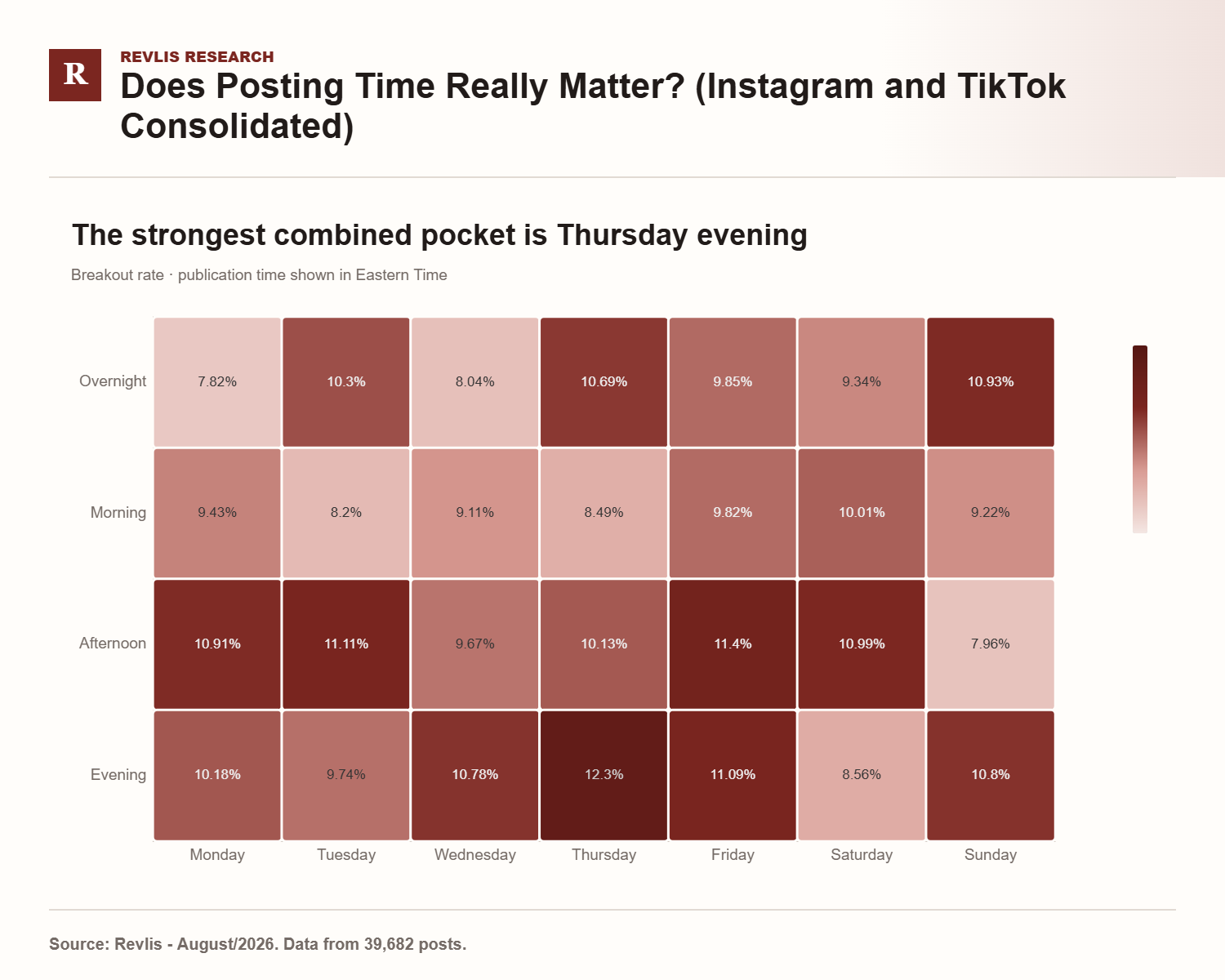
(Heatmap of breakout rates for 39,682 Instagram and TikTok posts by weekday and time of day. Thursday evening has the highest combined rate at 12.3%.)
Thursday evening was the strongest combined time in this study, but it was not a universal answer. The combined chart is made up of 73% Instagram posts. It also mixes creators with different audiences, topics, and posting habits. This result gives us one time worth testing. It does not tell us that every creator should post on Thursday evening. That difference matters because the goal of this study was never to replace one generic posting rule with another one. The platform split gives us a more useful answer.
The best Instagram posting times were spread out
Instagram did not have one clear winner across the week. Sunday overnight had the highest exact breakout rate at 11.73%, but that result came from only 341 posts. Thursday evening was almost the same at 11.63%, and that group included 1,101 posts.
The larger Thursday group gives us a steadier clue, but it still does not give every Instagram account a set posting time. The strongest times were spread across several parts of the week. That is consistent with our original belief that creators need to test what works with their own audience.
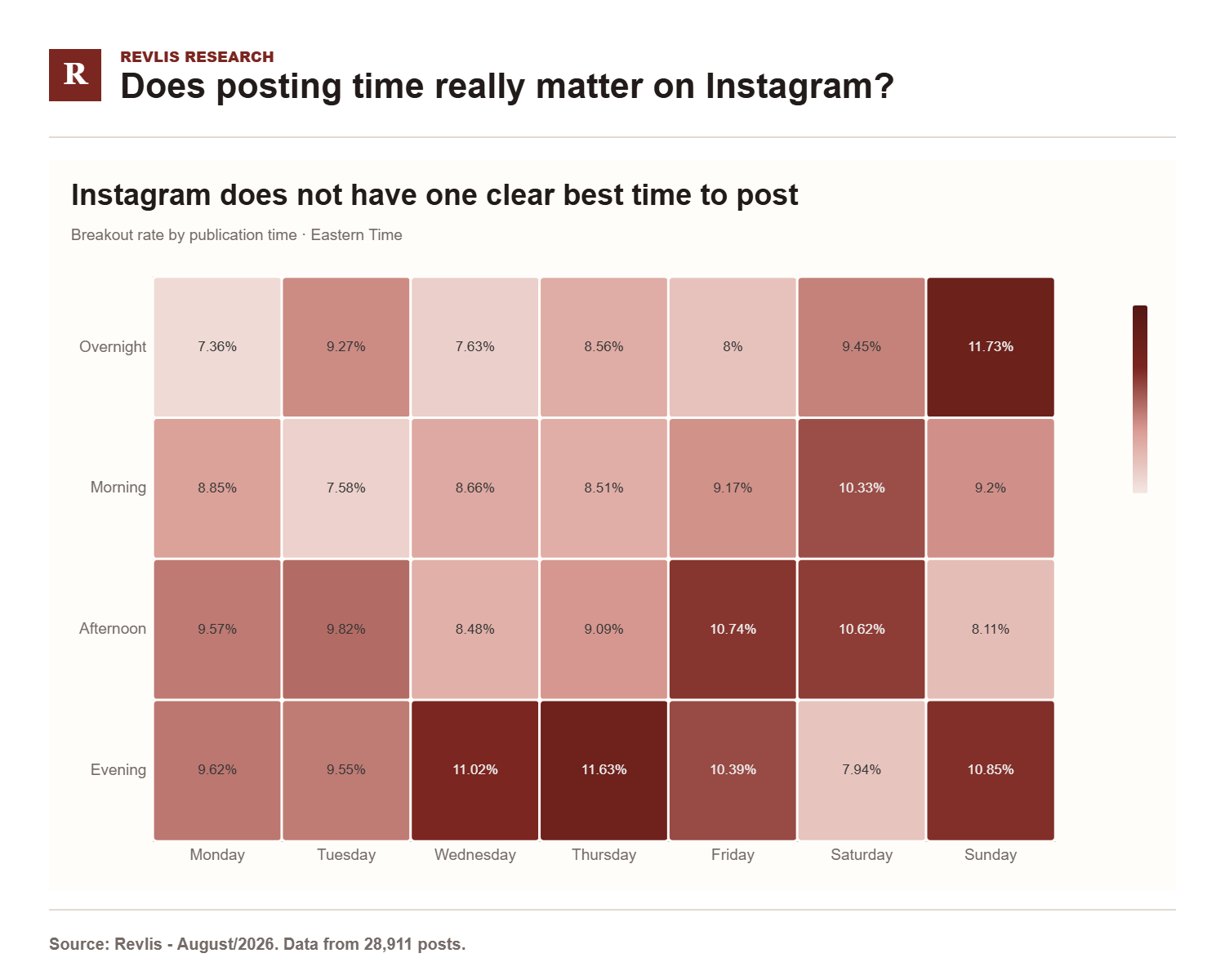
(Heatmap of Instagram breakout rates by weekday and time of day across 28,911 posts. Strong cells appear in several parts of the week, and there is no one clear winning time.)
The broader time blocks tell a clearer story. Instagram evening posts had a 10.20% breakout rate across 6,892 posts. Afternoon posts came next at 9.50%. Morning and overnight posts were both below 9%. Evening is one broad Instagram window worth testing based on this data. Compare it with a time that already fits your audience and schedule. The point is to test evening, not declare it the best time for every Instagram account.
TikTok changed more, but its biggest peak needs a warning
TikTok had sharper jumps across the calendar. Thursday overnight reached an 18.26% breakout rate, which looks huge beside the other cells. That result came from only 115 posts.
With a group that small, the real rate could move a lot as more posts are added. The range around that result was wide, from about 12.27% to 26.31%. It is an interesting clue, but it is not a schedule we would hand to every TikTok creator.
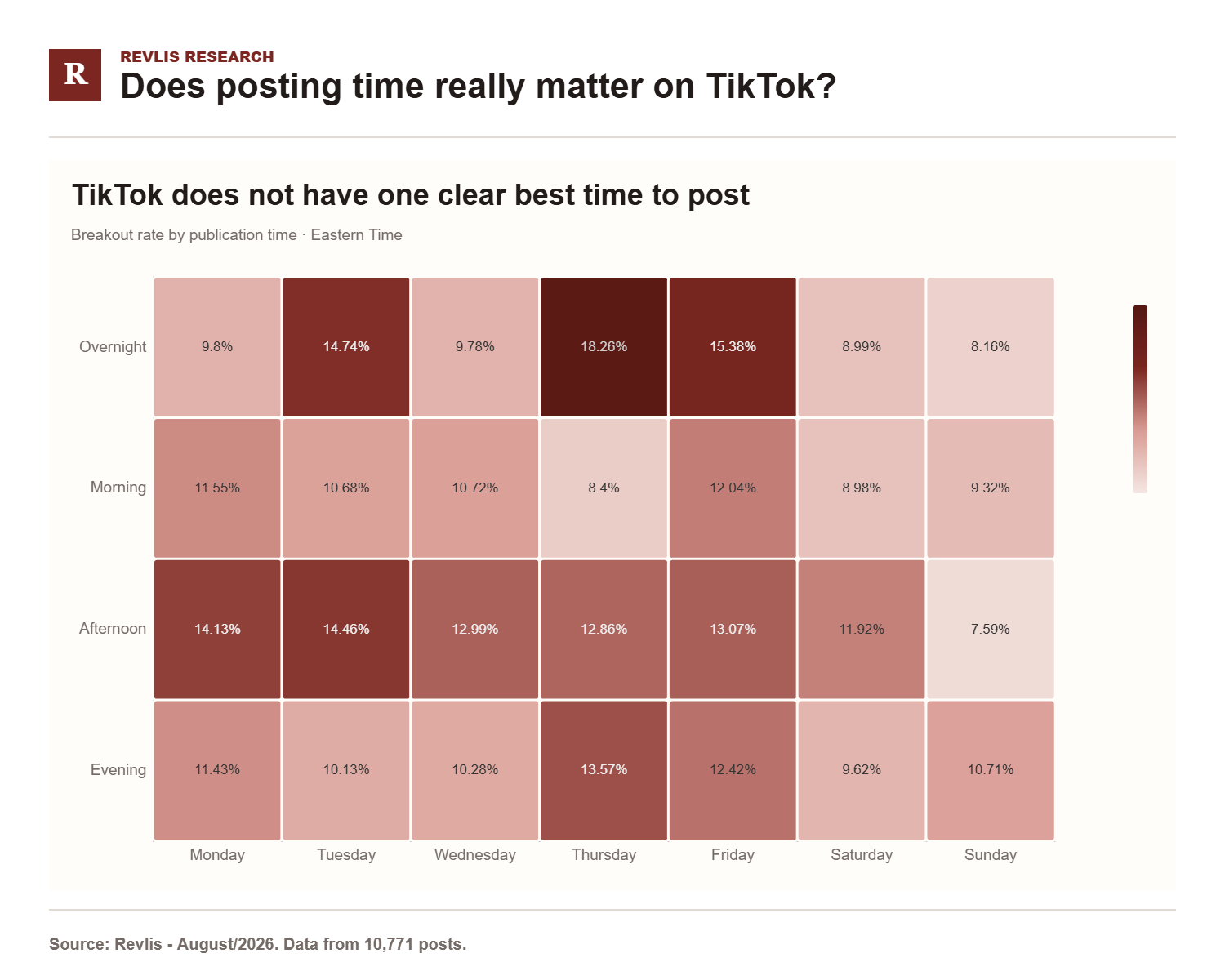
(Heatmap of TikTok breakout rates by weekday and time of day across 10,771 posts. Thursday overnight is the highest cell, but it contains only 115 posts.)
TikTok's broad afternoon group gives us a safer place to start. Afternoon posts had a 12.79% breakout rate across 3,926 posts. Tuesday afternoon was one of the stronger exact windows at 14.46% across 650 posts. That makes afternoon a better place to begin a TikTok test than Thursday overnight. The afternoon result came from a much larger group of posts, so it gives us more information. It still does not mean afternoon is the best time for every TikTok account.
Posting time changed the highest results more than the typical post
There is another part of the study that matters. The typical post stayed close to its creator's normal views across the different time blocks. The clock did not suddenly make the middle post take off.
The bigger changes happened near the top. Some time blocks had more posts that reached far above the creator's normal result. That is why timing looks more useful as a small edge for a strong post than as a fix for every post. A weak opening can still lose people at the "best" time. A clear, useful video can still break out outside the top cell. The time may help, but the post still has to give people a reason to watch.
Why do "best time to post" studies give different answers?
You can find a new best-time chart almost every week, and many of them disagree. That does not always mean one study is wrong. They may be measuring different things.
For example, [Buffer's 2026 Instagram study] used 9.6 million posts and found strong Instagram results on Wednesday and Thursday, with evenings doing well on most days. [Hootsuite's Instagram study] used more than one million posts and gave different windows by day, industry, and timezone. Our study looked at whether a post rose far above what that creator normally received on the same platform. Those are three different research setups.
The same thing happens on TikTok. [Sprout Social's 2026 TikTok study] found strong engagement from Tuesday through Thursday in the afternoon. Our TikTok data also gave the afternoon a strong broad result, but our exact calendar winner was a small overnight group. The metric, sample, date range, accounts, and timezone rules can all change the answer.
Public studies should help you choose what to test. They should not decide your schedule for you. This is also why Mosseri points creators toward their own Instagram Insights. Your audience’s activity and your actual post results should decide what stays in your calendar.
How to test the best posting time for your account
Start with two or three windows you can use every week. For Instagram, you might compare an evening window with one of your usual afternoon times. For TikTok, you might compare two afternoon windows with one evening window.
Keep the test simple:
- Use the same main audience for each group of posts.
- Keep the topic, video style, and post goal as close as you can.
- Use enough posts that one big hit cannot decide the whole test.
- Compare each result with your normal views. Do not judge the test by your highest post alone.
- Write down the day, time, topic, hook, format, and result.
- Check your audience's timezone before copying any public chart.
TikTok Studio includes viewer activity times in its analytics. Use that information with your own post results. A time when people are active can be a good test window, but the final answer should come from what your posts do over time. If one window keeps doing better, use it more often. If the results stay close, choose the time that is easier for you to manage. There is no reason to make your content process harder for a tiny difference that does not hold up.
So, should you care about posting time?
At Revlis, we do not believe there is one set posting time that works for every creator. This study did not find one clear posting time that worked across both platforms. Instagram and TikTok did not even point to the same broad time of day, and the strongest exact times were not always the most dependable results.
Posting time is still worth testing. Start with a few reasonable windows, look at when your audience is online, and compare the results with what your posts normally receive. Keep the times that continue to work for your account.
Do not hold a good post because the clock does not match a chart you found online. The content still has to give people a reason to watch, and your own results matter more than someone else’s perfect hour.
Method and limits
This study used 39,682 Instagram and TikTok posts from 324 account groups. Each group needed at least five measured posts, and each creator's Instagram and TikTok history was counted separately. The analysis compared every post with the views that creator normally received on the same platform.
The research used each post's latest saved view count, so older posts had more time to collect views. It used Eastern Time because we did not have the local time for each creator or audience. Creators who posted more often added more posts to the study, so they had more weight in the final numbers. The study shows a link between timing and results, but it does not prove that timing caused the result.
Turn psychology into content that converts.
Explore the platform behind The RevList and start building smarter campaigns.