The RevList by Revlis
Buffer for Social Media Managers: Is it enough?
If you manage social media for clients or brands, you've almost certainly used Buffer — or at least seriously considered it. It's clean, it's affordable, and it does exactly what it says on the tin. So the question isn't whether Buffer is good. It is. The question is sharper than that: is it enough for what your job has actually become?
That word — "enough" — is doing a lot of work. Enough to publish? Easily. Enough to keep a posting calendar tidy? Sure. Enough to justify a retainer, retain a client past month three, and prove that what you do moves a number that matters? That's a different conversation, and it's the one nobody selling you a scheduler wants to have.
This isn't a teardown. I used scheduling tools for years as a social media manager before I built anything of my own. What follows is the honest version of a conversation I have with other SMMs constantly: where a tool like Buffer fits, where it quietly runs out, and how to tell which side of that line your work sits on.
What Buffer is actually built for
Buffer was built around one core promise: take the admin of posting off your plate. You connect your channels, queue your content, and let it publish on a schedule. Pricing is famously simple — free for up to three channels, then roughly $6 per month per channel — which is part of why it became the default starter tool for creators and small businesses.
Over the years it's grown a tidy set of features around that core: smart scheduling that suggests posting times based on engagement data, a universal comment inbox, a "Create" space for storing ideas, an AI assistant for captions, posting streaks to build a consistent habit, and a link-in-bio Start Page. It's a well-made product with a clear philosophy: make publishing effortless.
And here's the important part — that philosophy is correct for who Buffer is built for. For a solo creator or a small business owner running their own accounts on the side, "make publishing effortless" is exactly the right job to solve. If that's you, Buffer is close to perfect and you can probably stop reading.
But "social media manager" is a different job than "person who posts." And the moment you're being paid for outcomes instead of output, the question of "enough" changes shape.
What Buffer does genuinely well
I want to be fair here, because tool comparisons that pretend the competitor is garbage are useless to you. Buffer is strong at a specific cluster of things, and if these are your bottleneck, it earns its price:
Frictionless scheduling across channels. Queue once, publish everywhere. The interface stays out of your way, which matters when you're doing this every day.
Per-channel pricing that scales gently. You pay for what you connect. For someone running a handful of accounts, that's honest and predictable.
Habit and consistency features. Streaks and queue management nudge you to show up regularly — and consistency genuinely is a real driver of reach.
A clean comment inbox. Managing replies in one calm place is a legitimate time-saver.
Fast adoption of new platforms. When Threads and Bluesky appeared, Buffer supported them quickly. A scheduler that keeps up with where audiences move is worth something.
None of that is faint praise. If the thing keeping you up at night is "I can't get posts out the door consistently," a scheduler solves it. The trouble starts when you mistake that problem for the problem.
The question behind the question
Before you can answer "is Buffer enough," you have to answer something uncomfortable first: what is your job, really?
Most social media managers, if they're honest, were sold a definition of the job that centers on volume. Post more. Post more often. Thirty pieces a month. The whole industry — including the tools — quietly trained clients to believe that what they're paying for is a quantity of posts. Which is why so many SMMs end up defending a $3k retainer by pointing at a content calendar full of squares.
Think about the actual work that produces results. It's not the act of scheduling a post — anyone can do that. It's the layer underneath: deciding who you're talking to and what will move them, studying why specific content performed, understanding the psychology of why a human stops scrolling, and reading last month's data closely enough to make next month's content better. That's the job. The posting is just where the job becomes visible.
So when you ask "is Buffer enough," what you're really asking is: does my toolkit support the part of the job that's hard and valuable, or only the part that's easy and commoditized?
Where Buffer stops: the other 80%
A complete social media workflow runs in five stages: strategy → research → planning → creation → iteration. Buffer lives almost entirely in the middle — planning (the calendar) and creation-lite (captions, the AI assistant) and publishing. That's real value. But look at what sits on either side of it.
Strategy — mostly absent
Buffer can hold your posts; it can't tell you who you should be talking to, what your content pillars are, which psychological triggers your audience responds to, or what "success" even means for this brand. There's no place to define a target audience's dreams, fears, and frustrations and have that flow into your content. Strategy lives in your head, a Google Doc, or a deck you rebuilt from scratch for the third client this quarter. The tool doesn't carry it.
Research — this is the real chasm
This is where the gap is widest, and where it matters most. Buffer is not a research tool. It won't pull a competitor's last 96 posts and tell you their average first-24-hour views, their outlier rate, their best posting days, or what their top-performing hooks have in common. It won't let you paste a viral video link and get back a breakdown of the hook, structure, psychology, and conversion path. It won't surface what's actually working in your niche by keyword.
And research isn't optional busywork — it's the difference between guessing and knowing. The old way of doing it (spreadsheets, manual tallies, 8–10 hours a month) is exactly the kind of work that makes SMMs feel underpaid. The new way is to understand why content performs and extract the repeatable pattern. A scheduler simply doesn't operate at this layer.
Psychology — not its domain
Why does a human stop scrolling in the first three seconds? What turns a passive view into a save or a share? Buffer's AI can help you phrase a caption faster, but it isn't built to engineer an identity play, an emotional arc, or an objection-handling sequence into a piece. The psychology — the part that separates content that gets views from content that gets results — isn't something a publishing tool concerns itself with. Fair enough; it's not what it's for.
Iteration — shallow by design
Buffer offers analytics, and they're fine for a tidy report: engagement, reach, optimal times. But there's a difference between reporting numbers and iterating on them. Iteration means looking at what worked and what didn't last month, understanding the reason, and rebuilding next month's hooks, formats, and messaging from that insight. Vanity dashboards tell you the score. They don't tell you why you scored it — or what to change.
The hidden cost of a scheduling-first toolkit
Here's the part that's bigger than any feature checklist. When your entire toolkit is organized around publishing, it quietly reshapes how you — and your client — define your value. If the tool's whole story is "post more, post easier," then "more posts" becomes the thing you're implicitly selling. And "more posts" is the single easiest thing in the world to commoditize.
This is the real risk, and it has three faces:
The industry that lied to you. Tools built around scheduling reinforced the idea that the job is scheduling. That's how a skilled strategist ends up justifying a retainer with a content calendar instead of a results story.
The false-promise machine. "Post 20 times a day." "Use these hashtags." "Here's a caption formula." Surface-level advice that scheduling tools are perfectly built to execute — and that produces the mediocre results clients churn over.
The commoditization trap. AI is collapsing the perceived value of surface work. If your offer is captions and a posting schedule, you're already replaceable. The SMMs who are safe are the ones operating at the strategy and psychology layer — the ones who can look at the data and explain exactly why something worked.
So the honest cost of "is Buffer enough" isn't a missing feature. It's that a posting-first workflow can train you to compete on the one dimension where you'll always lose. The tool didn't mean to do that. It's just what happens when the tool's worldview becomes yours.
Coverage map: Buffer vs. the full SMM workflow
Here's the same idea as a map. This isn't "Buffer bad" — it's a picture of which stages of the job a publishing tool is designed to touch, and which it isn't.
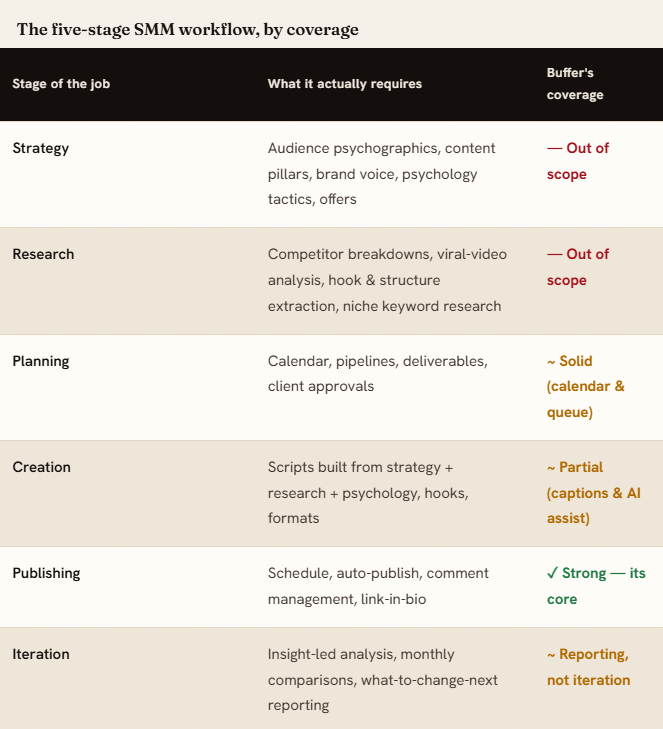
Read top to bottom and the pattern is obvious: Buffer is excellent at the bottom of the funnel of work (publishing) and thin at the top (strategy and research), which is where the value — and the defensibility of your job — actually lives.
So… is it enough? An honest verdict
Here's the straight answer: Buffer is enough if your job is to publish content. It is not enough if your job is to produce results.
For a creator, a side-hustle, or a small business owner who just needs to show up consistently, it's a great pick and you shouldn't overthink it. For a social media manager who's paid for outcomes, Buffer covers the easy, visible 20% of your work and leaves the hard, valuable 80% — strategy, research, psychology, iteration — entirely to you and a pile of disconnected docs and spreadsheets.
That's not a flaw in Buffer. It's a category boundary. Buffer is a publishing tool, and you can't fault a publishing tool for not being a strategy system. The mistake is expecting one tool to do both — and quietly accepting a smaller definition of your job because the tool you reached for only solved the small part.
What "enough" actually looks like
If you're on the right-hand side of that self-test, "enough" doesn't mean a better scheduler. It means adding the layer Buffer was never built to provide: a system that runs the whole workflow from strategy through research, planning, creation, and iteration — so the hard 80% of the job stops living in your head and your browser tabs.
That's the gap Revlis was built to close. It's not another calendar or posting tool. It's a system for social media managers that starts where the strategy starts: define an audience's real psychology, research competitors and viral content to extract why they win, turn that into scripts engineered with hooks and pacing and persuasion, run it through a client-ready pipeline, and then iterate from the data instead of guessing. Psychology first, strategy second, creativity third.
You can keep Buffer to publish if you love it — plenty of people pair a scheduler with a strategy layer. The point isn't to swap one tool for another. It's to stop pretending the easy part was ever the whole job.
Frequently Asked Questions
Is Buffer good for social media managers?
Yes. Buffer is one of the most user-friendly social media management tools available and is excellent for scheduling content, managing publishing calendars, and maintaining posting consistency. However, many social media managers eventually discover that scheduling is only a small part of their job. Research, strategy, competitor analysis, content planning, script writing, and performance iteration often require additional tools. Revlis was built to help social media managers manage those higher-value parts of the workflow.
What is the best Buffer alternative for social media managers?
The best Buffer alternative depends on what you need. If your primary goal is scheduling and publishing content, Buffer remains a strong option. If your workflow includes competitor research, viral content analysis, content strategy, psychology-driven script creation, client approvals, and performance optimization, Revlis offers capabilities that traditional scheduling platforms typically do not provide.
Does Buffer offer competitor research?
Buffer provides analytics and engagement reporting, but it is not designed as a competitor research platform. Social media managers often rely on manual research, spreadsheets, or separate tools to analyze competitor content. Revlis helps streamline this process by allowing users to analyze competitors, identify top-performing content patterns, and uncover the psychological triggers behind viral posts.
Can Buffer generate social media content ideas?
Buffer includes AI-assisted content features that can help generate captions and basic post ideas. However, most people still need to conduct research to determine what topics, hooks, and formats are working within their niche. Revlis combines content research, viral video analysis, competitor intelligence, and script generation to help users create content ideas backed by data rather than guesswork.
Is Buffer enough for social media agencies?
For some agencies, Buffer may be enough for scheduling and publishing. As agencies grow, many require deeper workflows involving client collaboration, strategy documentation, content planning, approvals, competitor research, and performance analysis. Revlis was built specifically for social media managers and agencies that need support across the entire content lifecycle rather than just publishing.
What tools do social media managers use besides Buffer?
Many social media managers use multiple tools alongside Buffer, including Notion for planning, Google Sheets for research, ChatGPT for content creation, Loom for client communication, and analytics platforms for reporting. Revlis aims to consolidate many of these workflows into a single platform designed specifically for social media management.
Is Buffer better than ChatGPT for social media content?
Buffer and ChatGPT solve different problems. Buffer focuses on publishing and scheduling content, while ChatGPT helps generate ideas and written content. Many social media managers use both. Revlis bridges the gap by combining content research, psychological analysis, script creation, content planning, and workflow management into one system.
How do social media managers research viral content?
Most social media managers manually review competitors, analyze trending videos, track engagement metrics, and document patterns in spreadsheets. This process can take several hours each month. Revlis was built to reduce that workload by helping users identify successful content patterns and understand why specific videos perform well.
What is the difference between a social media scheduler and a social media strategy platform?
A social media scheduler focuses on publishing content at the right time. A social media strategy platform helps determine what content should be created in the first place. Scheduling tools optimize distribution. Strategy tools optimize decisions. Revlis focuses on the strategic side of social media management by helping users research competitors, understand audience psychology, create stronger content, and iterate based on performance data.
What is the best social media management software for agencies outside of Buffer?
The best software depends on the agency's workflow. Platforms like Buffer, Hootsuite, and Sprout Social are strong publishing tools. Agencies focused on content strategy, research, psychology, script writing, and performance-driven content creation may benefit from a platform like Revlis that was built specifically for modern social media management workflows.
Turn psychology into content that converts.
Explore the platform behind The RevList and start building smarter campaigns.