The RevList by Revlis
Can Claude Analyze TikTok and Instagram Videos
Claude can respond to supplied text and images. Revlis is built to analyze public TikTok and Instagram posts as moving social content.
You paste a TikTok or Instagram Reel into Claude and ask it to break down the hook, explain why the video worked, or analyze the creator’s content. Instead of getting the analysis, Claude tells you it cannot access the video as expected or asks you to provide the material another way.
This happens often enough that people are actively looking for workarounds. One person with about 20 saved Instagram posts said Claude “can’t seem to open them and analyze” them.[1] Another person researching Reels did not want to “manually take notes” on every video.[2] Someone else described the search for a solution as “browser rabbit holes.”[3]
Then the work starts moving back to you. You take screenshots, find or create a transcript, copy the caption, explain the important visual moments, and make notes about the account. Before Claude can help with the analysis, you have already assembled most of the information it would need.
Can Claude analyze TikTok and Instagram videos?
Claude does not currently provide a standard consumer workflow where you paste a public TikTok or Instagram link and it watches and analyzes the native social video for you.
Anthropic’s current upload guidance lists supported documents and images, but it does not list a standard video format.[4] Its vision documentation explains how Claude analyzes images, including multiple supplied images.[5] That means Claude can respond to a transcript, screenshots, caption, comments, or notes you provide. It is responding to those inputs, though. It is not automatically studying the moving post, its performance context, and the creator’s wider account from the social link.
That distinction becomes important when the question is not simply, “What did this person say?” You are usually trying to work out why someone stopped scrolling, what held their attention, why the post outperformed the creator’s normal content, and which parts are worth testing in your own strategy.
What Revlis keeps together when it analyzes a video
With Revlis, you can import a public TikTok or Instagram link directly. The post is saved and queued for deep analysis, so you do not have to keep the link in a random folder or prepare the post for the tool yourself.
Revlis analyzes what happens frame by frame and second by second. It keeps the visual, audio, spoken language, on-screen text, pacing, cuts, sentiment, structure, and psychology connected to the moment in which they occur.
A transcript is useful, but it is a record of the words. A screenshot captures one visual moment. A social video is the relationship between all of those pieces over time.
For example, a video might open with a calm question, cut at three seconds to a second speaker with a louder and more authoritative response, reinforce the question with on-screen text, and keep one curiosity loop open until the payoff. The transcript can show the question and answer. A few screenshots can show the speakers. Neither one, on its own, explains how the interruption, timing, tonal shift, visual contrast, and payoff work together to hold attention.
That is why the Revlis post breakdown goes beyond a summary. Depending on the post, you can examine:
the hook formula and hook overview;
the opening visual, first spoken line, on-screen text, audio context, pacing, and cuts;
the curiosity gap, open loops, stakes, and payoff;
the video structure and video style;
the message angle, emotional signals, and psychology drivers;
the relationship between the hook and the rest of the video;
similar audio, visual, and text hooks; and
reusable takeaways that can inform an original next post.
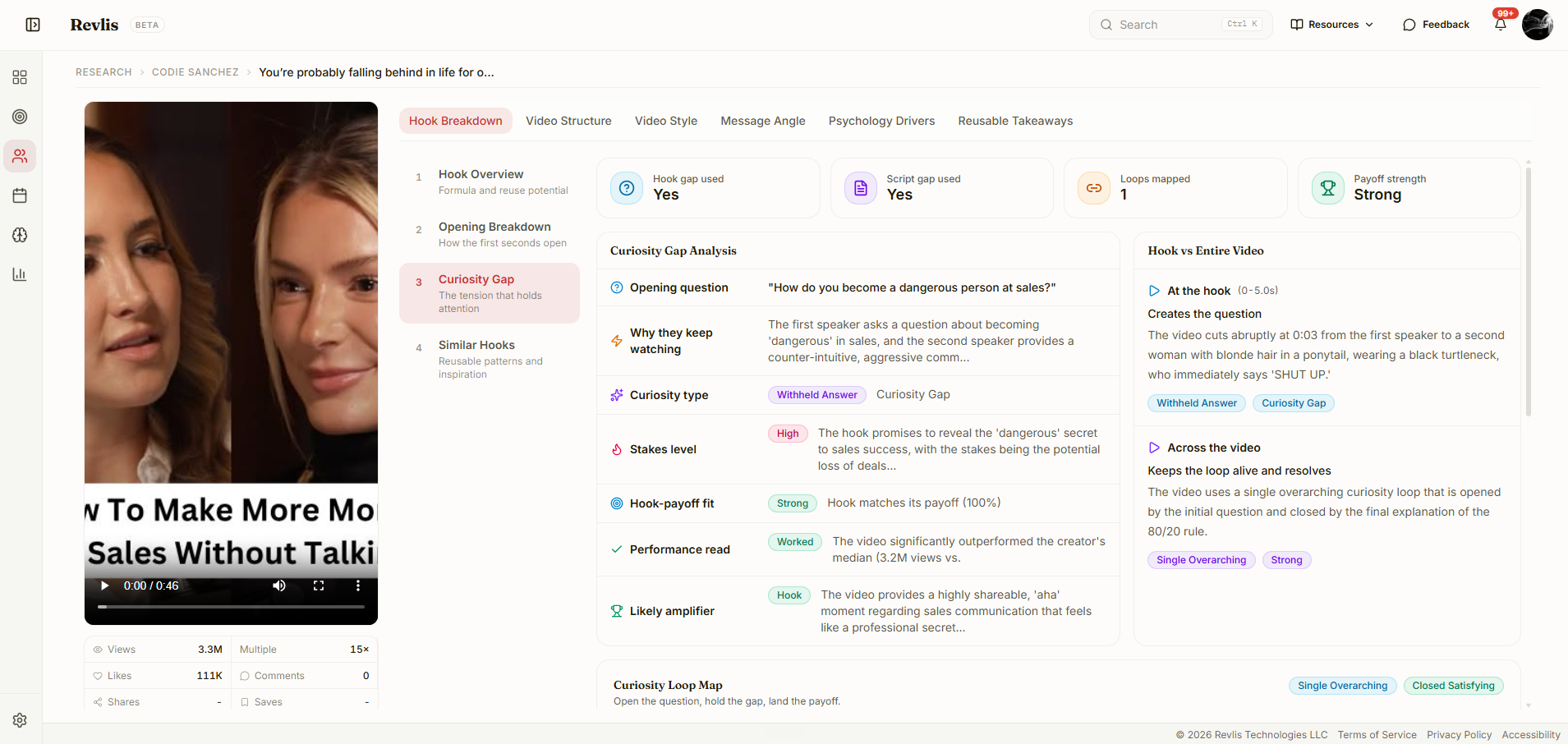
In this Codie Sanchez example, the opening question is connected to the cut at 0:03, the second speaker’s response, the curiosity loop across the video, and the final payoff. The analysis is useful because those moments stay connected. You can see what the hook promised, how the video kept that question alive, and whether the ending actually resolved it.
People trying to build similar workflows around Claude have described capturing videos frame by frame or combining still frames with a timestamped transcript so the model has more of the editing context.[6][7] Revlis handles that analysis as part of the product workflow instead of asking you to assemble the moving post by hand.
Why account context changes what you learn from one video
A strong-looking post is not automatically a useful pattern. You need to know whether it was actually unusual for that creator.
When Revlis analyzes a public TikTok or Instagram account, it brings in approximately the latest 100 posts available in the account run. Every video receives analysis. For normal posts, the first five seconds receive the deepest hook-level analysis. When a post is identified as an outlier, the full video receives the deeper teardown. A post imported directly by link also receives a full deep analysis.
That wider account view lets you ask better questions:
Was this post an outlier, or does most of the account perform this way?
Which hooks, structures, styles, topics, or message angles repeat across the winners?
What do the lower-performing posts do differently?
Is the opportunity in the topic, the creative execution, the audience psychology, or a combination of them?
Which element can you adapt to your strategy without copying the creator’s content?
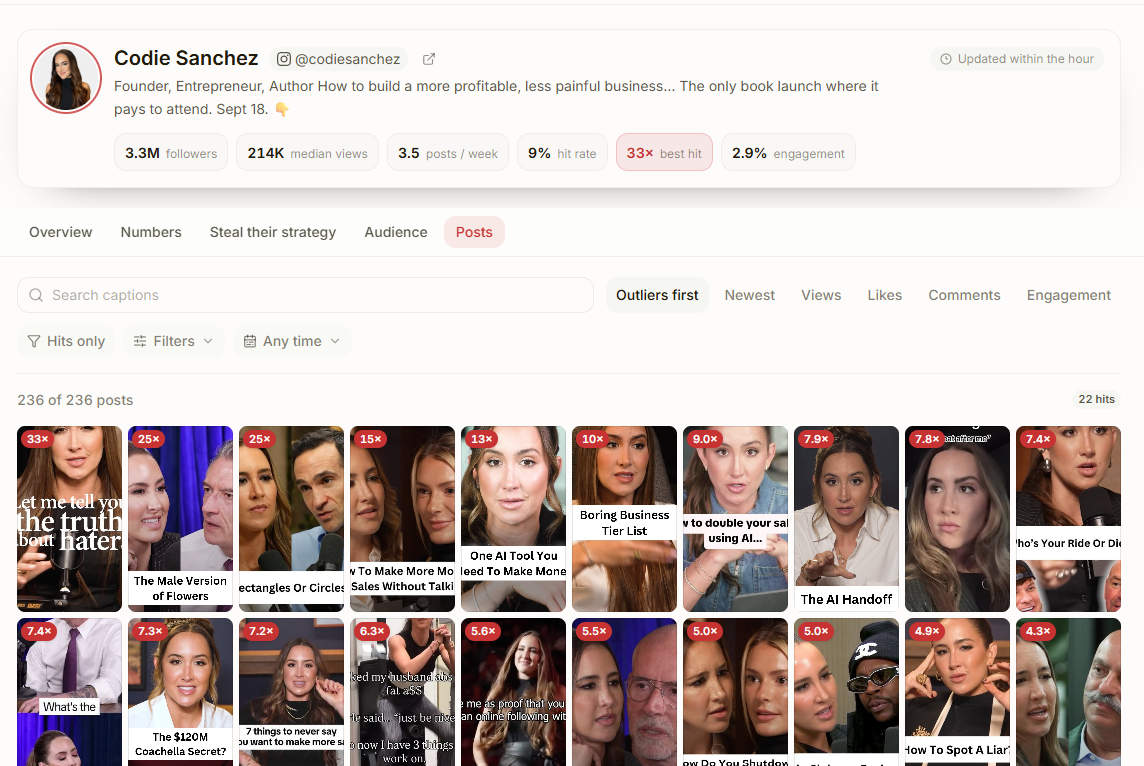
The Codie Sanchez post library shows the outliers beside the rest of the account. That baseline matters. Instead of choosing a video because it looks impressive, you can see how far it performed above the creator’s normal results and then inspect what the winners have in common.
Account context also changes how Revlis interprets the individual post. The system can compare a creator’s videos with the other videos from that creator and with the growing set of creators and posts collected in the Revlis database. That makes it possible to find related concepts based on what a video means and how it is constructed, not only whether two transcripts use the same words.
From one useful pattern to an original next script
Once Revlis identifies something useful, you can keep exploring it. Similar hooks can be separated into audio, visual, and text-hook examples. You can also look for related video styles, video structures, message angles, and broader concepts through dedicated pages, search, filters, and analysis-generated recommendations.
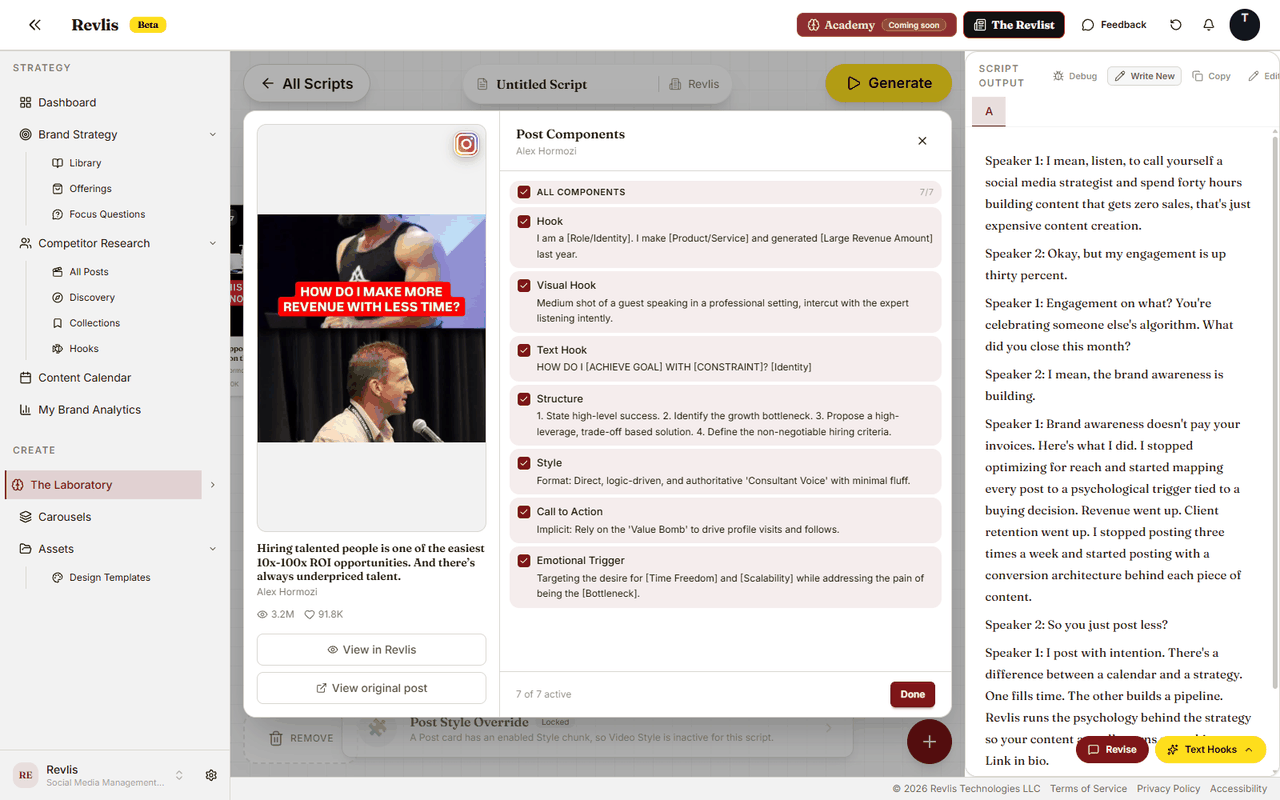
The useful parts of a post are then templatized into components. In the Laboratory, you can choose the pieces you actually want to work with, such as the hook pattern, visual direction, structure, style, call to action, or emotional trigger. You can add your own strategy, educational input, audience context, and point of view before generating a script.
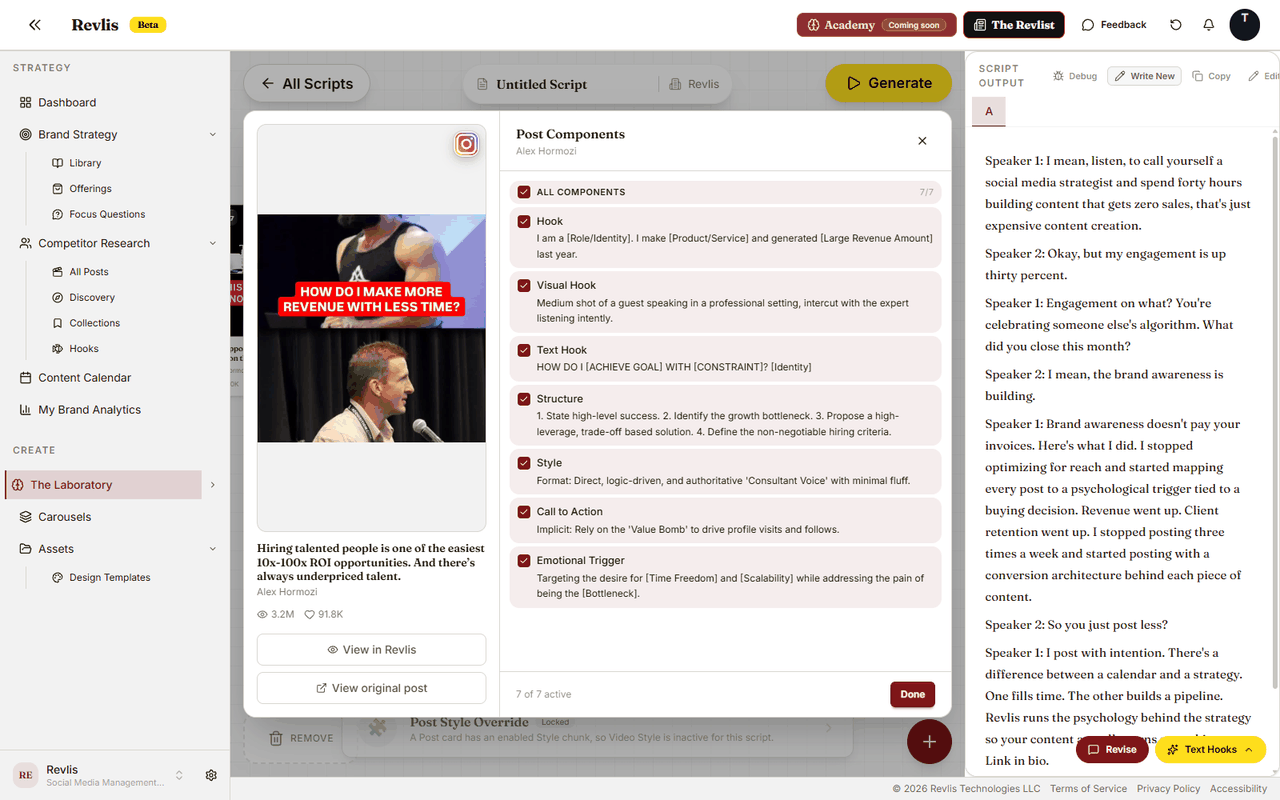
This is not a tool for copying an outlier video. Revlis helps you separate the useful mechanism from the creator-specific content, decide which elements fit your strategy, and write an original version. You can create another iteration, save the script to the content calendar, and connect it to the deliverable you are responsible for producing.
That is the part most video-analysis answers leave out. Understanding a post is helpful. Being able to move from the research into a strategy-backed script is what makes the analysis usable.
When should you use Claude, and when should you use Revlis?
Use Claude when you already have the material and want help reasoning through it. A supplied transcript, set of screenshots, research document, or creative brief can give Claude enough context to help you think, organize, or write.
Use Revlis when the job begins with a public TikTok or Instagram post and you need the tool to analyze the social video itself. It is the better fit when you want a detailed post breakdown, the creator’s account context, similar creative patterns, and a direct path from the research into an original script.
Scope and limitations
Claude’s capabilities can change over time, and a custom technical setup may behave differently from the standard consumer workflow described here. Revlis currently supports public TikTok and Instagram posts. Account runs cover approximately the latest 100 available posts, depending on what the platform makes available.
For the wider analysis method, see What Is a Viral Video Breakdown - How to Analyze Viral TikToks and Reels.
Sources
Reddit user report: “Link Claude to Insta to summarize posts?”↩︎
Reddit user report: “Instagram Reels web scraping”↩︎
Reddit user report: “Claude Code can now play TikTok videos”↩︎
Anthropic Support: Upload files to Claude↩︎
Reddit user report: “Adding unsupported files to project files”↩︎
Reddit user report: “Made a skill to help Claude watch videos”↩︎
Turn psychology into content that converts.
Explore the platform behind The RevList and start building smarter campaigns.