The RevList by Revlis
ChatGPT vs Gemini vs Claude vs Revlis for Social Video Analysis
A transparent same-link test of four AI workflows for social-video analysis, including the manual work required and what still needs testing.
We gave ChatGPT, Gemini, Claude, and Revlis the same public TikTok link and asked the same simple question:
“Analyze this video and break it down for me.”
The post was a public Leila Hormozi TikTok. We did not give the three general-AI tools a downloaded video, transcript, screenshots, caption, or manual notes. We gave them the link and the request—the way a person would when they want help understanding a competitor post without doing all of the prep work first.
This is not a “which AI is smartest?” test. It is a much more specific question:
If I paste a public TikTok link into the tool, can it actually start the social-video analysis I came for?
Here is what happened.
What ChatGPT did with the TikTok link
ChatGPT was straightforward about the limitation in this test. It said it could not accurately analyze the specific TikTok from the URL alone because the link did not expose the video's actual content in a way it could access. It then recommended three options: upload the video, upload a screen recording, or paste a transcript.
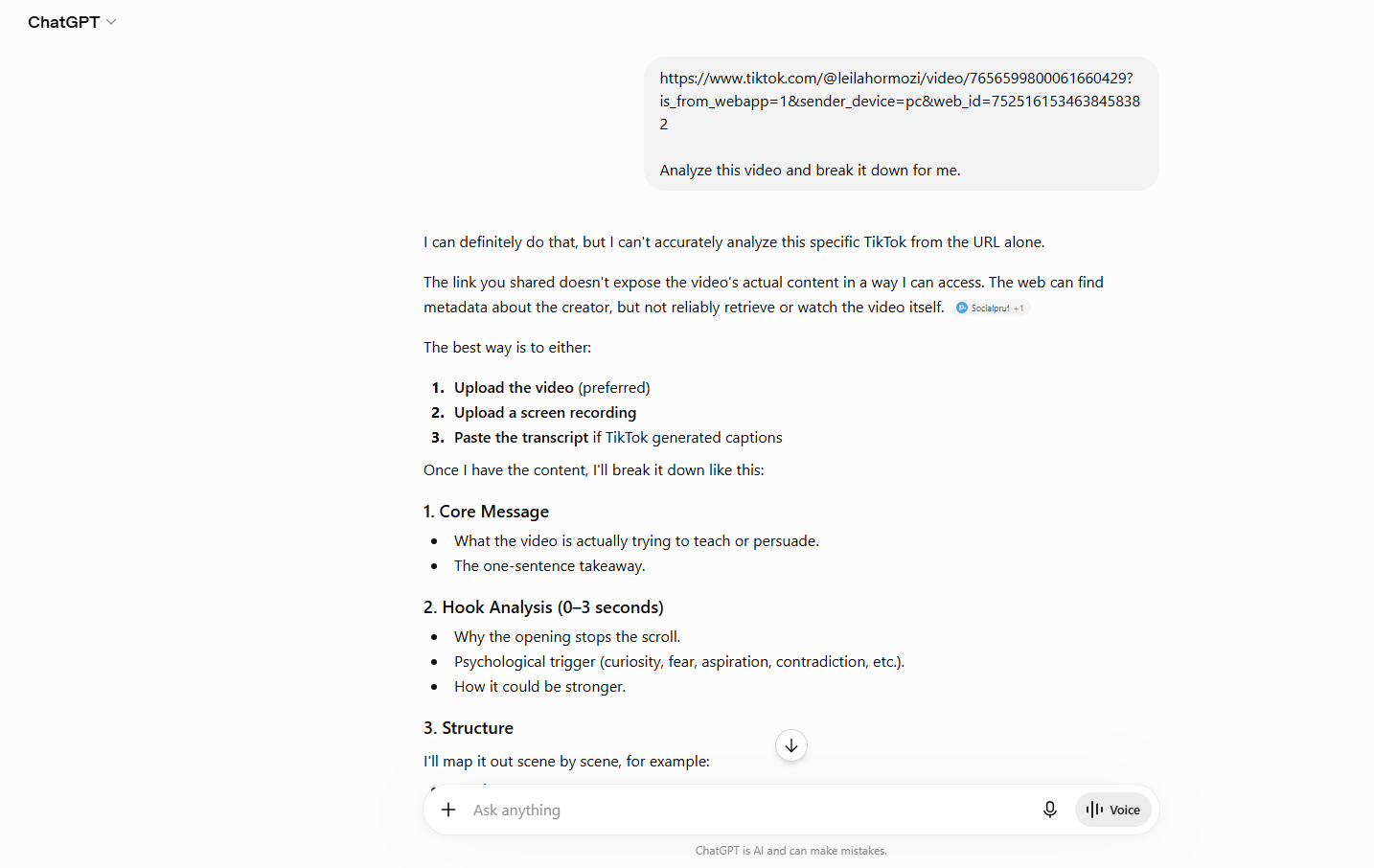
(ChatGPT reponse to the same TikTok link, stating it cannot accurately analyze the specific video from a URL.)
The reason is simple. ChatGPT does not watch a video from a link. And even when you do hand it a file, it isn't watching the way you are—it samples still frames and reads the transcript, then reasons over those pieces. From a bare URL it has none of that. So it asks you to go get it.
That is helpful if you already have the video, a screen recording, or a transcript. But if your actual goal is “help me understand this competitor post,” the work has now moved back to you.
You need to get the video. Then decide which screenshots matter. Then explain the visual moments, audio, cuts, caption, performance context, and the thing you want compared. ChatGPT can help once that context exists. This test shows that it did not create that context from the public TikTok link.
What Gemini did with the TikTok link
Gemini gave an even shorter answer. It said it did not have the ability to directly access or play video content from third-party links outside YouTube, including TikTok and Instagram. Because it could not watch the video natively, it said it could not analyze it or provide a breakdown.
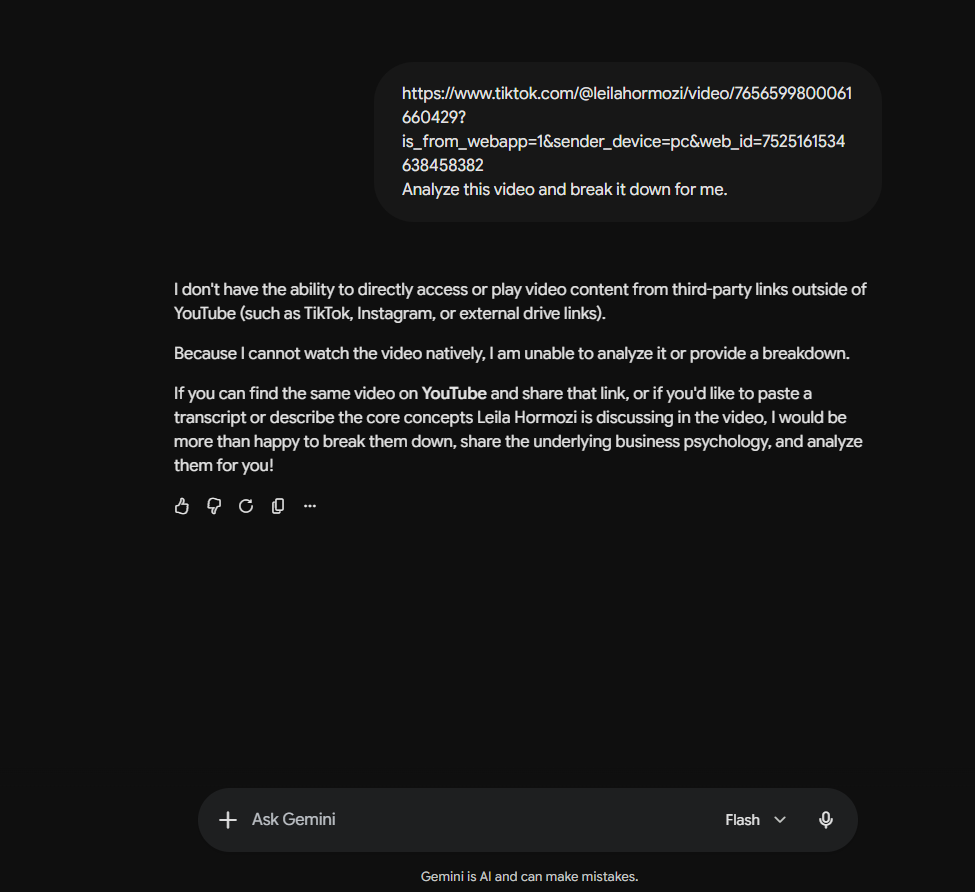
(Gemini response to the same TikTok link, stating it cannot directly access or play TikTok and Instagram video links or provide a breakdown.)
Gemini can analyze uploaded video in documented workflows. This was not an uploaded-video test. It was a public-TikTok-link test, and Gemini did not analyze the link we gave it.
Here is the part worth sitting with. Of these three tools, Gemini is the strongest at actually understanding video, it can watch an uploaded clip natively, frame by frame, with the audio. And it still would not touch the link. That tells you the wall isn't intelligence. It's access. Even the best video AI in the group cannot start from a TikTok URL.
That distinction matters because marketers are usually not sitting there with a neatly prepared MP4. They find a competitor post, see something worth studying, and want to know what made it work. If the first step is downloading and organizing every file yourself, the “quick analysis” becomes a manual research process.
What Claude did with the TikTok link
Claude tried to fetch the URL. In the screenshot, it reports that TikTok blocks automated access to its pages, says it could not retrieve the video directly, and says it does not want to invent an analysis of content it has not seen.
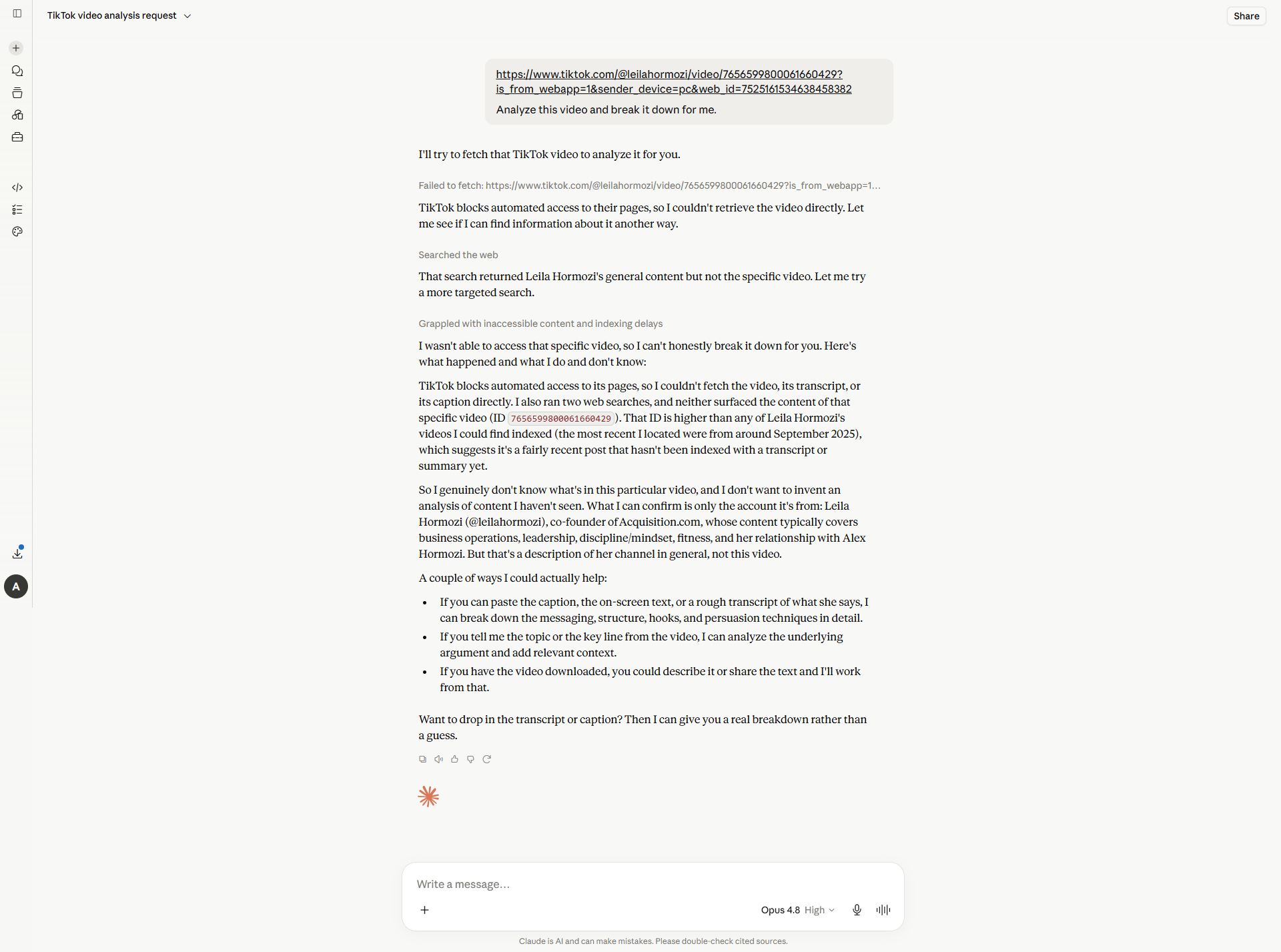
(Claude response to the same TikTok link, showing a failed fetch, TikTok access block, and a request for caption, transcript, or downloaded-video context.)
Claude was the only one that actually tried. It reached for the URL, hit TikTok's block on automated access, and then did the honest thing, it refused to invent a breakdown of a video it never saw. That's two walls, not one: it can't get past the platform, and it can't natively watch the video even if it could.
That is an honest response was from Claude. It is also why people get frustrated when they are trying to study social content. Claude can help if you paste the caption, on-screen text, a rough transcript, or a description. But those are pieces of the video. The person asking the question still has to gather them and decide what matters.
For one post, you may be fine doing that. For a competitor account, a client report, or a library of saved content, you end up with a folder of downloads, screenshots, transcripts, notes, and prompts before you have learned anything useful.
What Revlis did with the TikTok link
Revlis accepted the same public TikTok URL in its import flow. The import screen says the post will be saved to the default collection and queued for analysis.
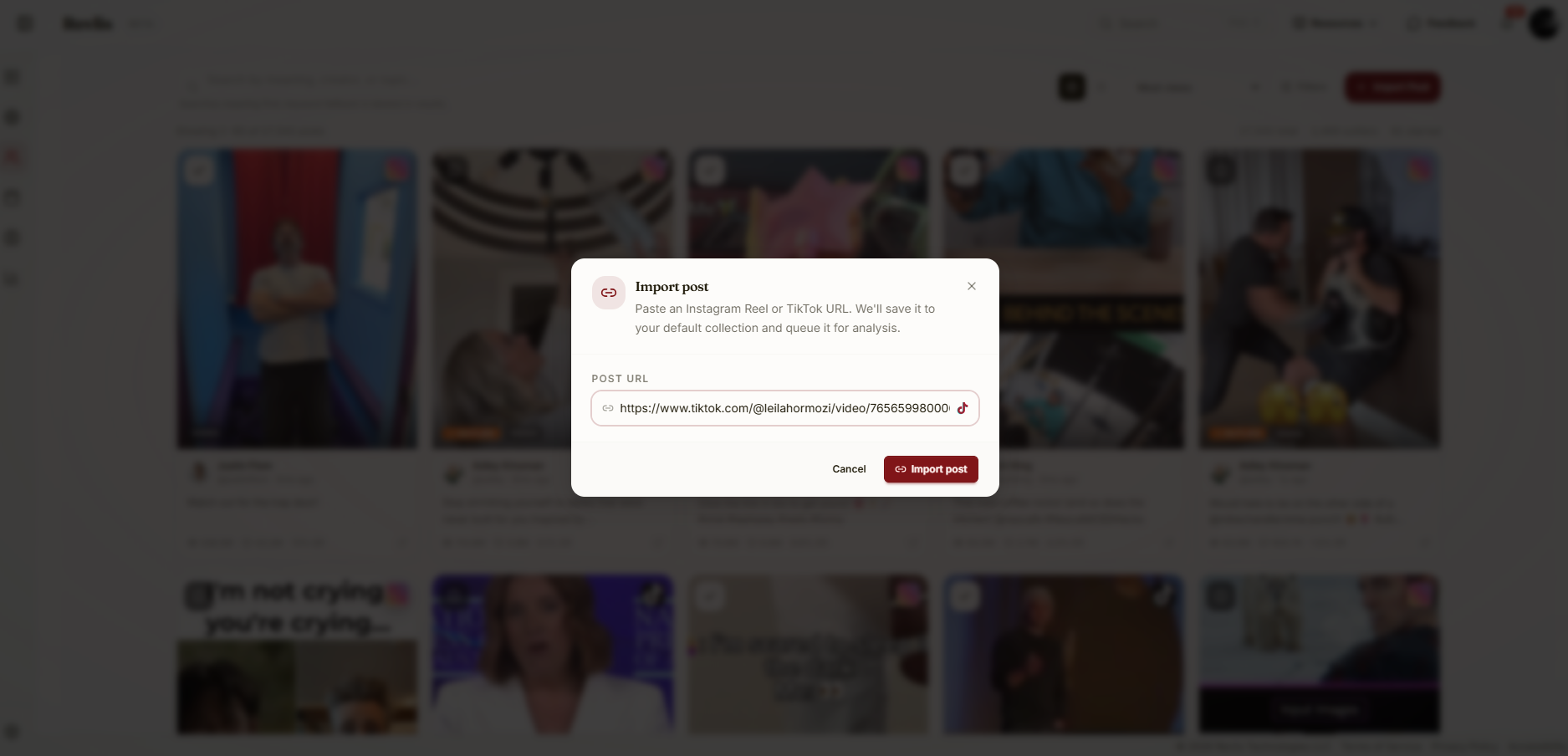
(Revlis import-post screen accepting the same public TikTok URL and queuing it for analysis.)
That sounds simple, but it changes the workflow. You are not being asked to turn the video into a transcript, a set of screenshots, and a long prompt before the research can begin. You paste the public TikTok or Instagram link, then Revlis handles the analysis and saves the post as research you can return to.
The Leila Hormozi post is shown in the image below and shows the kind of detailed breakdown Revlis produces after analysis.
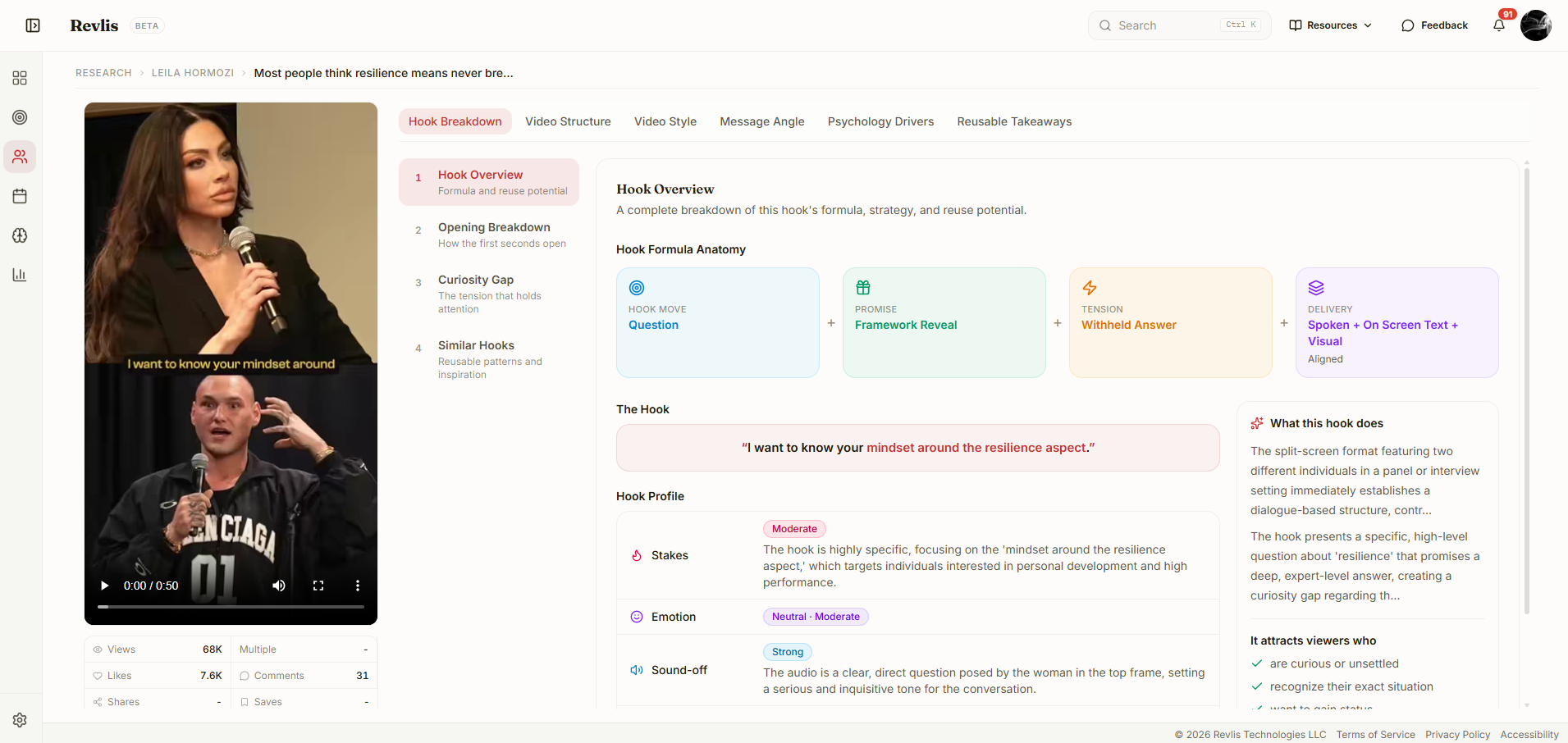
(Revlis hook-breakdown example from a different post, showing hook formula, opening, visual/audio/text alignment, pacing, stakes, emotion, and first-five-seconds analysis.)
This is what makes Revlis different from a transcript or a basic description of the subject. It studies what viewers saw and heard, what the opening did, how the video changed across time, what psychological tension it created, and whether the rest of the post paid that off.
Accepting the link is step one. Here is what happens next.
Once the post is in, Revlis doesn't hand you a transcript and call it analysis. It runs the video through a fixed set of analysis passes, each looking at a different layer of why the post worked.
It watches the video, not just the words, transcribing the audio with timestamps and speakers separated, then reading the footage frame by frame, closely across the opening seconds and across the full runtime after that.
It studies the first few seconds on their own- the opening frame, the first line, the on-screen text, the exact mechanism that opens the curiosity gap, and the stakes being set.
It profiles the post across dozens of attributes- hook type, promise type, funnel stage, creator archetype, psychological tactic, and more- so posts become comparable instead of one-offs.
And it benchmarks the post against the creator's own numbers, so a genuine outlier stands apart from an average post (this step runs when a competitor account is loaded into Revlis, not on a single imported post).
Here is the real difference. Asking an AI to "analyze this video" is one question against one clip you had to prepare yourself. Revlis runs the same rigorous set of questions across every post and turns the visuals, audio, and transcript into something it can compare against a creator's entire body of work.
To Summarize...
Tool | What we gave it | What the screenshot shows | What that means for the workflow |
|---|---|---|---|
ChatGPT | Public TikTok link + “Analyze this video and break it down for me.” | It says it cannot accurately analyze the specific TikTok from the URL alone and asks for an upload, screen recording, or transcript. | You need to prepare more material before the analysis starts. |
Gemini | Same public TikTok link + same request | It says it cannot directly access or play third-party video links outside YouTube and cannot provide a breakdown. | The direct-link workflow stops before analysis. |
Claude | Same public TikTok link + same request | It attempts to fetch the TikTok, reports an automated-access block, and says it cannot honestly break down the specific video. | You need another way to provide the video or its context. |
Revlis | Same public TikTok link | It accepts the link in the import flow and queues the post for analysis. | The link is the starting point for the research workflow. |
That is the difference this article is about.
The question is whether you have to do the work of collecting and translating the post before the tool can help you.
What this test does—and does not—show
This test shows what happened when we gave four tools the same public TikTok link and the same short request on July 13, 2026.
It shows that, in this direct-link test:
ChatGPT asked for more material before it could accurately analyze the TikTok.
Gemini said it could not directly access or play the TikTok link.
Claude attempted retrieval, reported a TikTok access block, and asked for more context.
Revlis accepted the public TikTok link and queued it for analysis.
Frequently asked questions
Are there tools that can analyze social media posts?
Yes. Revlis can analyze individual public TikTok and Instagram posts from a link. It breaks down the hook, opening, visual/audio/text alignment, curiosity gap, video structure, style, message angle, psychology drivers, and reusable takeaways. Then you can bring the useful elements into the Laboratory to write an original script.
Can ChatGPT analyze TikTok or Instagram links?
No. ChatGPT cannot directly analyze TikTok or Instagram links. It asks you to upload the video, provide a screen recording, or paste a transcript instead. If you want to paste a public TikTok or Instagram link or account and get a detailed post breakdown, use Revlis.
Why can't ChatGPT analyze TikTok or Instagram links?
Because ChatGPT does not have access to the actual TikTok or Instagram video from the public link. It can see limited page information, but it cannot reliably watch the video, hear the audio, or study the visual and editing details that make up a post breakdown. Revlis is built to analyze those public posts from the link itself.
Can Gemini analyze TikTok or Instagram links?
No. Gemini cannot directly analyze TikTok or Instagram links. It may be able to analyze a video after you download and upload the file, but that is not the same thing as pasting a social link and getting a detailed breakdown. Revlis lets you paste the public TikTok or Instagram link and queues the post for analysis.
Why can't Gemini analyze TikTok or Instagram links?
Gemini does not directly access or play TikTok and Instagram videos from those public links. That means it cannot watch the post, hear the audio, or break down the opening from the link alone. Revlis is built for that specific social-video workflow.
Can Claude analyze TikTok or Instagram links?
No. Claude cannot currently analyze TikTok or Instagram links. It cannot directly watch the post from the link, so it asks you for a transcript, caption, screenshots, or a downloaded video. If you want the post itself analyzed from a public TikTok or Instagram link, use Revlis.
Why can't Claude analyze TikTok or Instagram links?
Claude cannot directly retrieve and watch TikTok or Instagram videos from those public links. Without the actual moving video, it cannot give you a real post breakdown. Revlis can import public TikTok and Instagram posts directly, then analyze the hook, visuals, audio, structure, psychology, and reusable takeaways.
Turn psychology into content that converts.
Explore the platform behind The RevList and start building smarter campaigns.