The RevList by Revlis
How to Analyze a TikTok or Instagram Account With AI
See how AI can study TikTok videos, Instagram Reels, and public accounts without turning competitor research into hours of manual scrolling.
If you want to analyze TikTok videos with AI, starting with one video is easy enough. You can upload the file to an AI video analyzer, add the transcript, and ask what it notices. You can do the same with an Instagram Reel. But then you find a creator or competitor whose whole account is doing something interesting. Their videos have a recognizable feel. A few posts are taking off. People in the comments keep responding to the same ideas.
So you open the account and think, I need to figure out what they are doing. Then you have a few hundred posts to look through.
You can watch the top TikToks or Reels, save links, take screenshots, copy captions into a doc, and ask AI to help you make sense of it all. But you still have to remember what was normal for the account, which videos truly stood out, what changed in the opening, and whether you found a repeatable pattern or one post that happened to travel. That is the difference between analyzing one social video and analyzing the account behind it. This guide will show you what an AI account analysis should study, where public data runs out, and how Revlis handles the job.
Can AI analyze a TikTok or Instagram account?
Yes. Revlis can analyze a public TikTok or Instagram account by its handle. It currently reviews approximately the latest 100 public posts in an account run, then lets you study the account as a body of work. You can compare its normal posts, standout posts, formats, openings, and recurring creative patterns.
It does not promise an account's entire historical archive. It cannot see private reach, watch time, revenue, conversions, or every reason a creator's content performs. Public social data has limits, and a useful analysis needs to be honest about them.
Approximately 100 recent posts is still a much stronger starting point than opening an account, watching six videos, and hoping you happened to choose the right six.
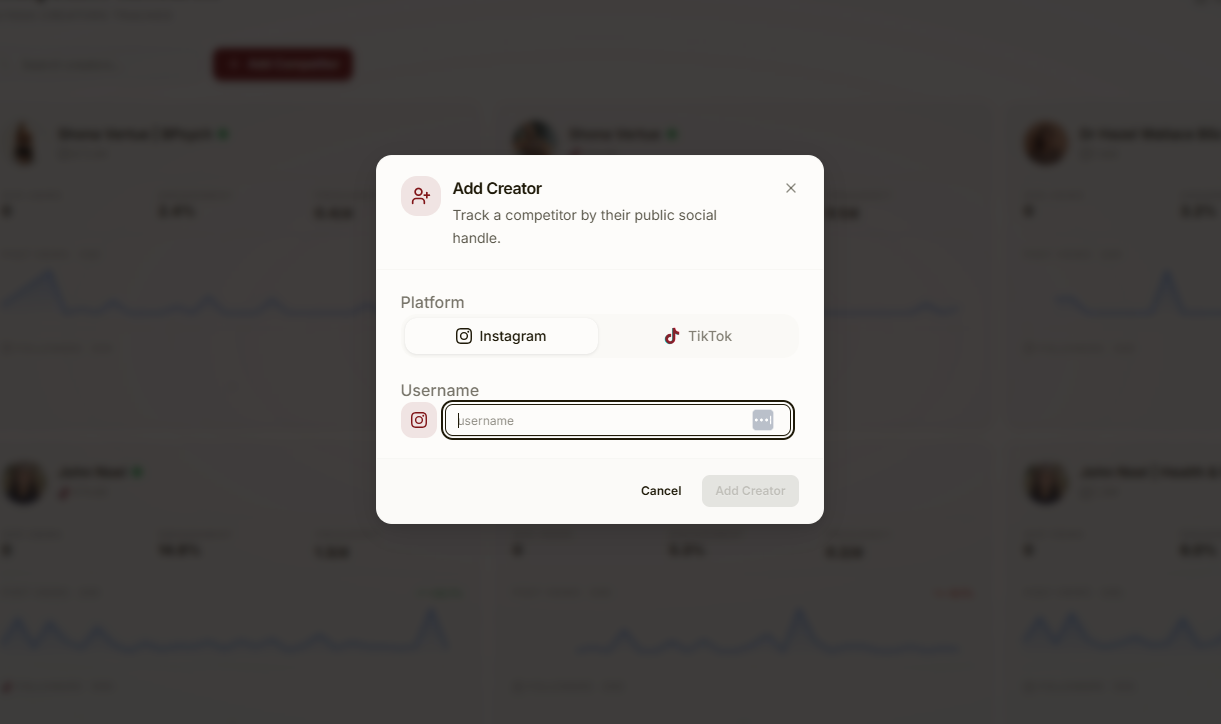
(Revlis Add Creator screen, where a user chooses public Instagram or TikTok and enters a creator handle to queue the account for analysis.)
To start, you choose Instagram or TikTok, add the public handle, and queue the creator for analysis. You do not have to download dozens of videos and build the research set yourself.
What a TikTok video analyzer or Instagram Reel analyzer should actually read
A useful TikTok video analysis or Instagram Reel analysis needs more than a caption and transcript. The words matter, but so do the opening visual, on-screen text, voice, music, pacing, cuts, expressions, and the order in which the viewer receives the information.
Think about a Reel that opens with a surprising object on screen while the creator says something ordinary. A transcript-only summary may capture the sentence and miss the part that made someone stop. The same thing happens when the text hook, spoken hook, and visual hook make different promises. Revlis keeps those parts together. It can study the spoken words, visual opening, on-screen text, audio, timing, hook, video structure, message angle, emotional signals, and payoff as one moving piece of content. That gives you a social video breakdown instead of a text summary wearing a video label.
Why TikTok and Instagram account analysis needs normal posts
The top posts are usually where people start. That makes sense. You want to know what won.
The problem is that a top post has no context by itself. It may be genuinely different from everything else the creator makes. It may use a familiar format that works often for them. The creator may already have audience trust around that subject, or the video may have received distribution you cannot see from public information.
You need the normal posts too. Revlis gives you the account-level context around the videos: the creator's posting rhythm, typical view range, hit rate, top posts, active formats, and the post library in the available research window. That lets you compare a standout post with what that creator normally publishes instead of treating raw views as a complete explanation.
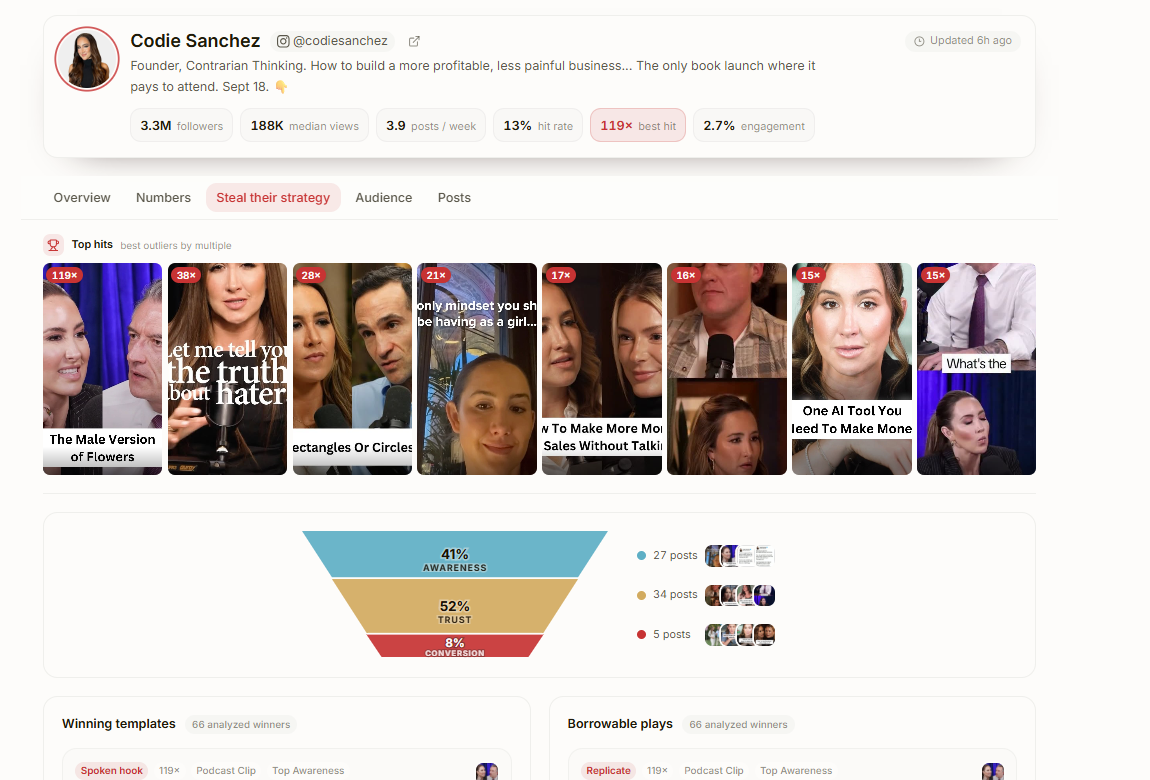
(Revlis account overview for Codie Sanchez, showing account context, top hits, recurring hooks, formats, emotional signature, and the relationship between analyzed posts and deeper reads.)
For example, the Codie Sanchez account view does not stop at a row of videos with large numbers on them. It shows the top hits, recurring hook language, active formats, emotional patterns, and the broader set of posts those observations came from. Now the useful question becomes, What is this account repeatedly doing that I should study?
What a TikTok or Instagram account analysis should include
Whether you use Revlis or another social media account analysis tool, the result should help you understand more than follower count and raw views. Revlis can surface:
- top hits and posts that outperformed the creator's usual baseline;
- the complete post library within the account run, so you can see normal posts alongside the hits;
- recurring hooks across spoken words, on-screen text, and visuals;
- video formats, styles, structures, pacing, and editing patterns;
- message angles, audience awareness, emotional signals, and psychology drivers;
- the difference between what a strong post promises in the opening and how it pays that promise off; and
- similar hooks, styles, structures, and patterns that are worth studying further.
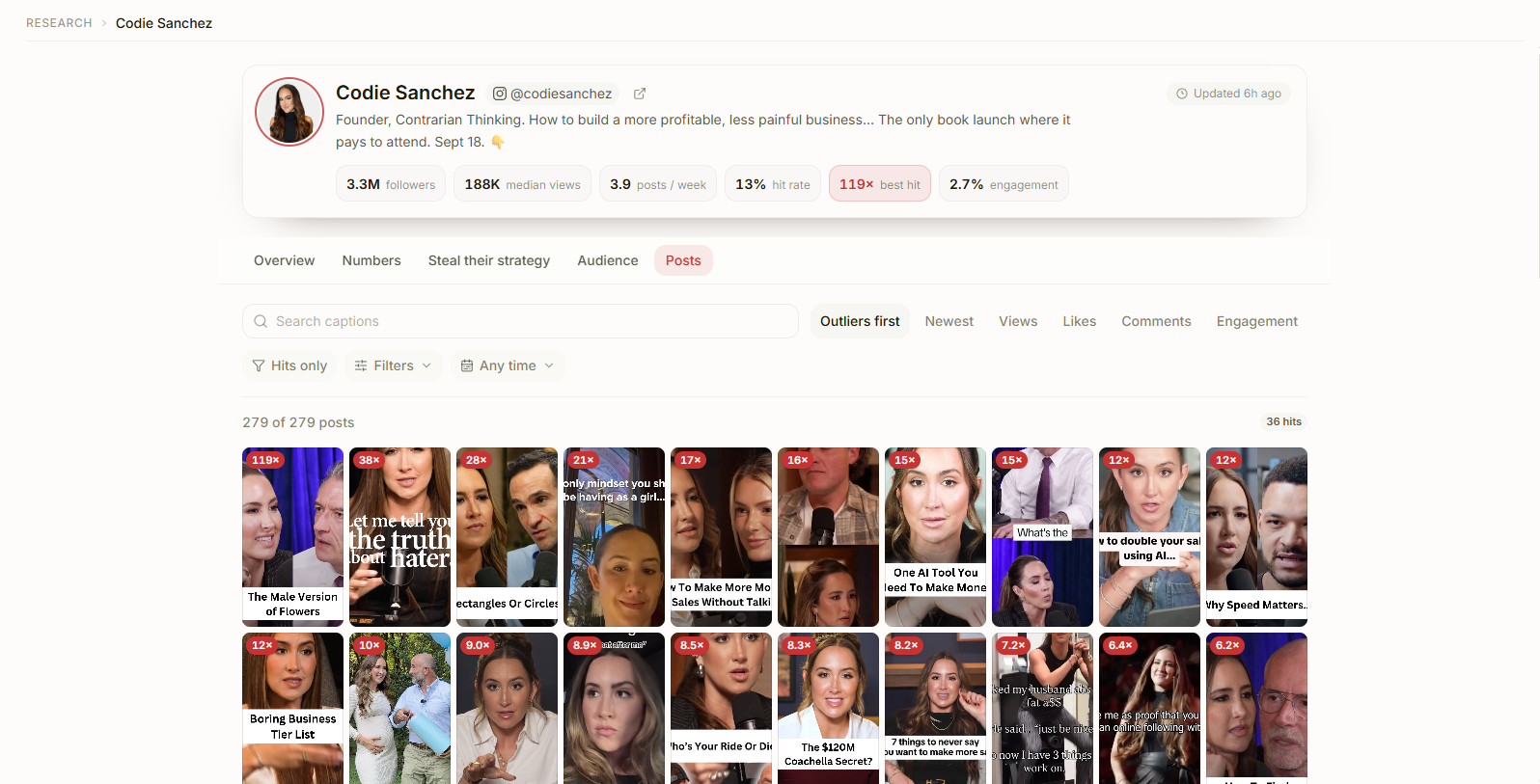
(Revlis post library for a public creator account, displaying the available account-run posts and showing outliers first.)
What an outlier video can show you
Every normal post in an account run is analyzed. Revlis applies the deepest hook-level read to the first five seconds of those normal posts, because that is where people decide whether they are staying or leaving. Outliers get the deeper full-video analysis. That is where you can go past "this hook was good" and see what the post was doing as a whole.
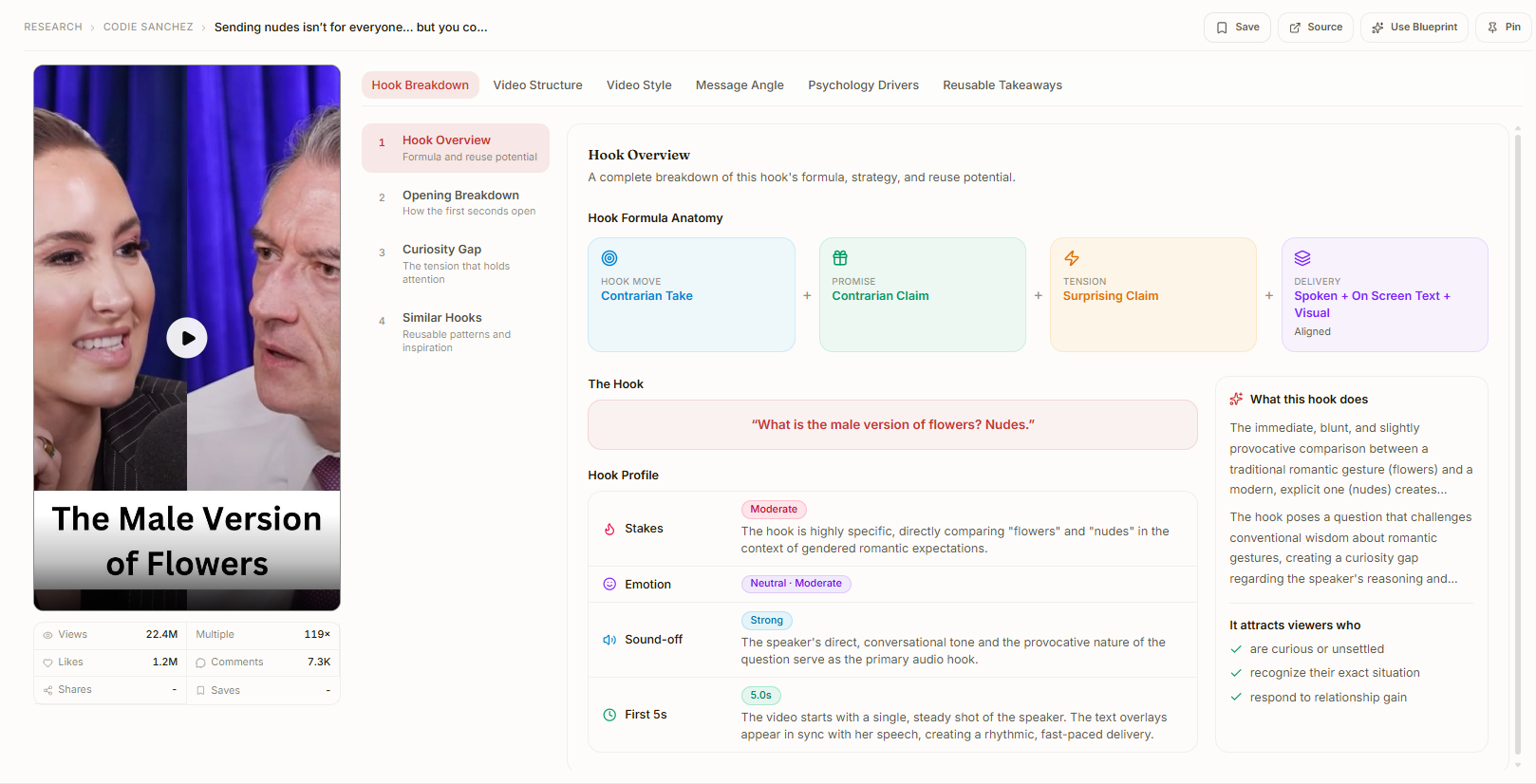
(Detailed Revlis hook breakdown for a Codie Sanchez outlier post, showing the hook formula, opening, stakes, emotion, sound-off, and first-five-seconds analysis.)
Inside a detailed breakdown, you can study the hook formula, opening sequence, curiosity gap, similar hooks, video structure, video style, message angle, psychology drivers, and reusable takeaways. The opening breakdown keeps the spoken line, on-screen text, opening visual, pacing, cuts, and audio context together. The first few seconds of a good video are rarely just one clever sentence.
The goal is not to say, "This got views, so copy it." A strong post can be useful evidence without being a template you should recreate word for word.
Why a chatbot prompt is not an account-analysis workflow
A general AI chat can be helpful once you give it the material: a transcript, screenshots, captions, notes, or a downloaded video. It can help you organize those inputs, think through an idea, or turn research into writing. But that is still a workflow you have to build. For real account analysis, the system needs to collect the available posts, preserve their source context, compare normal posts with outliers, and keep the visual, audio, spoken, and performance evidence connected.
If the job is to understand one supplied transcript, that may be enough. If the job is to understand the account behind the videos, you need an account-analysis workflow.
Turn TikTok or Instagram competitor analysis into an original post
Research becomes useful when it changes what you make next.
In Revlis, useful parts of an analyzed post can move into the Laboratory as cards. You can select the hook move, video structure, message angle, psychology driver, or video style that is relevant to your strategy, then add your own audience, offer, and point of view before writing a script.
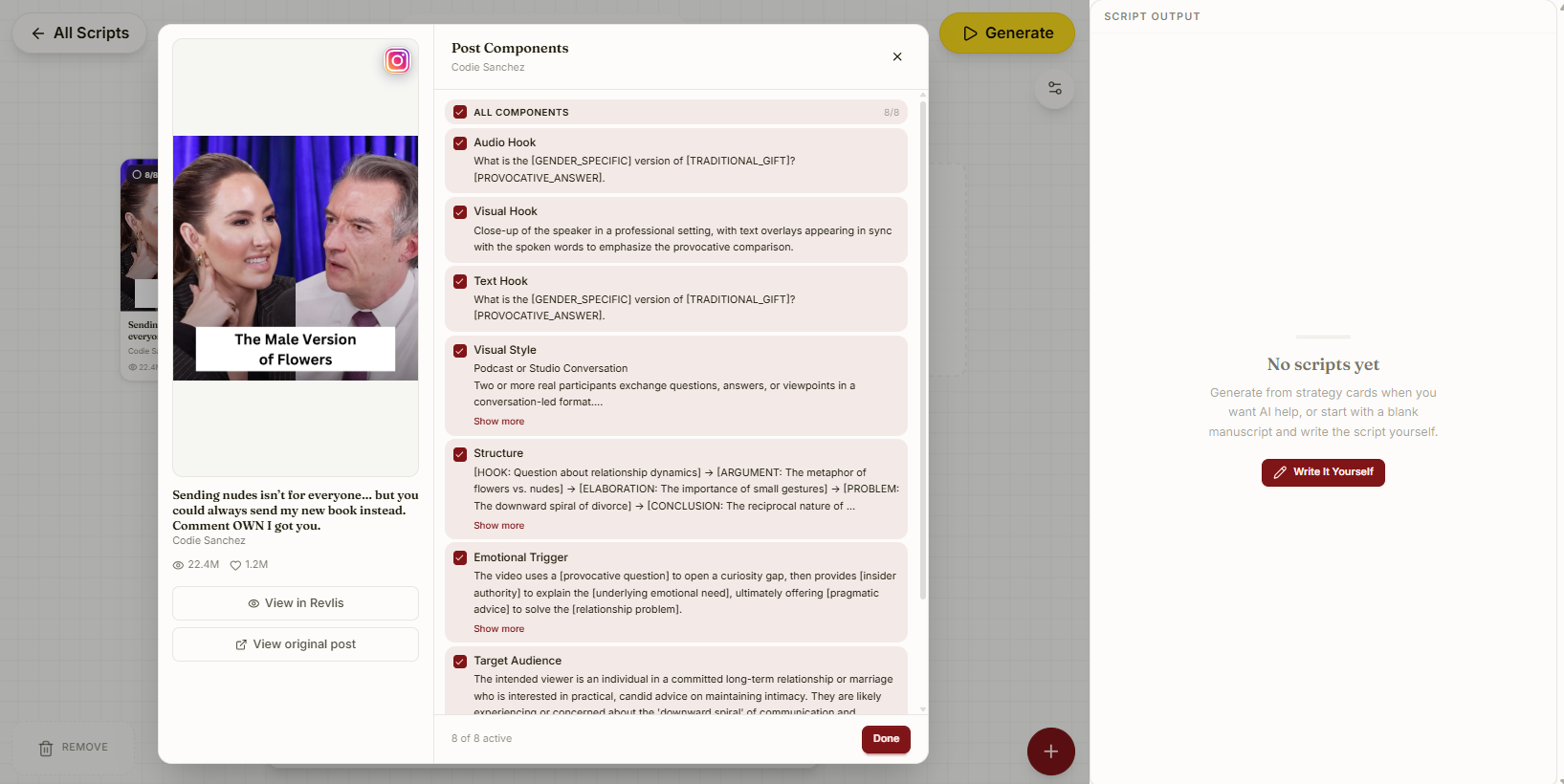
That script can then be saved into the content calendar and connected to a deliverable. Instead of keeping a random list of creator links you will probably never open again, you have a path from something you noticed to an original piece of content you can make.
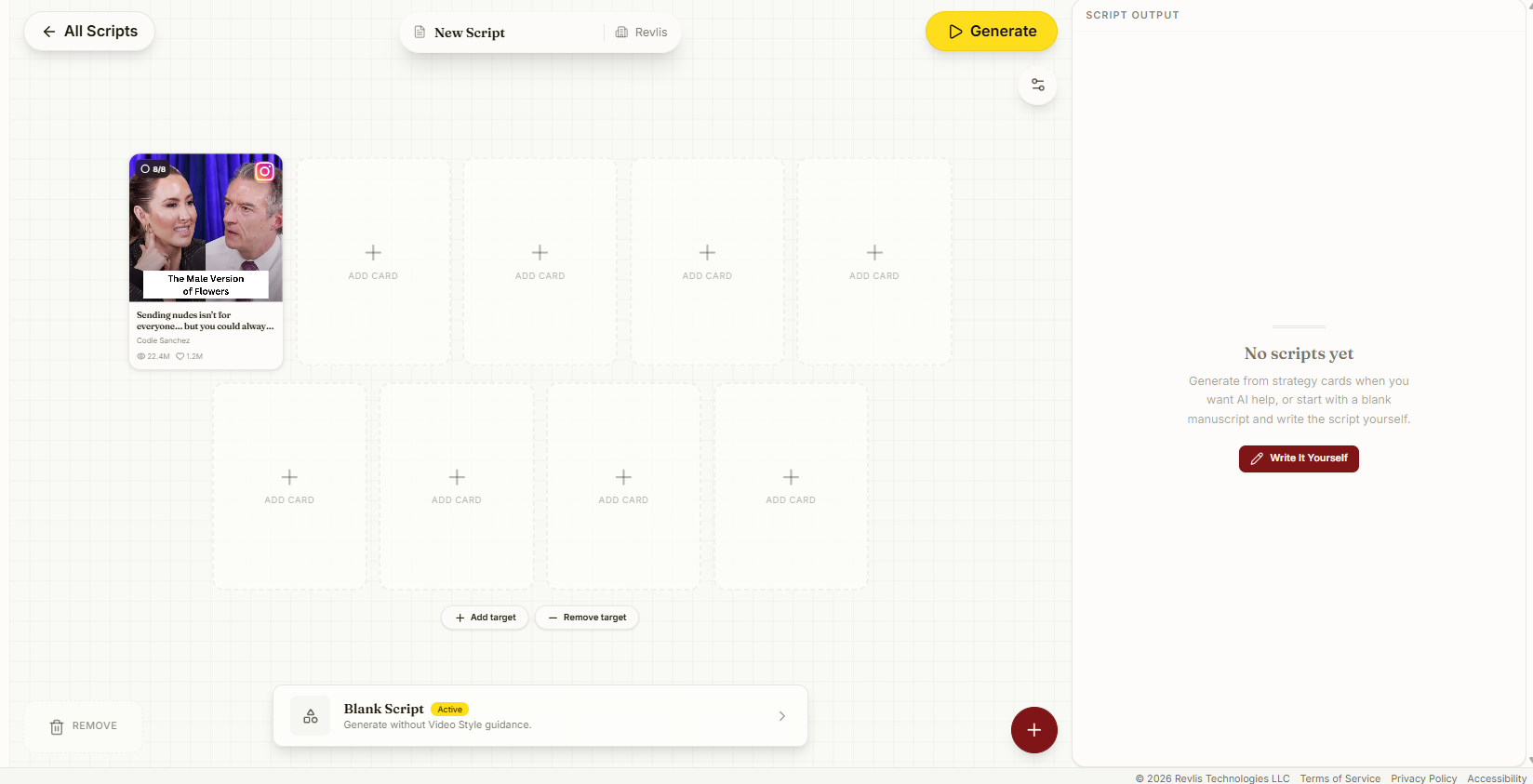
The patterns in the strategy view are there to help you understand the research, not recreate another creator's video. You still decide what makes sense for your audience, your offer, and the message you want to be known for.
What public TikTok and Instagram account analysis cannot tell you
There are still things a public account analysis cannot see:
- private reach, retention, watch-time, conversion, revenue, and attribution data;
- the full historical archive of an account;
- whether a creator used paid distribution or outside promotion on a particular post;
- the strength of audience trust that was built off-platform or over years; and
- a guaranteed reason a post performed the way it did.
Those limits do not make the research useless. They keep you from turning one observation into a made-up certainty.
Use the analysis to find patterns, understand what is visible, and choose the next original test. Then pay attention to what happens with your own audience.
Try Revlis For Free
Turn psychology into content that converts.
Explore the platform behind The RevList and start building smarter campaigns.