The RevList by Revlis
How to Analyze a Viral Video (3 real breakdowns)
We ran three real videos through the same seven-layer breakdown, 7M views, 1.2M, and 380K. The first thing it revealed: the 380K post was the most viral of them
Ask "how do you analyze a viral video?" and the usual answers are a checklist: look at the hook, check the metrics, read the emotion. All true but it's all incomplete. A real analysis is an order of operations that ends with something usable — the repeatable pattern behind why the video worked. So instead of explaining it in the abstract, we ran three real videos through the exact same seven-layer breakdown to show you the method.
And before we touch a single hook, the three of these videos expose the most common mistake in viral analysis: assuming the video with the most views is the most viral.
The three videos (and the surprise)
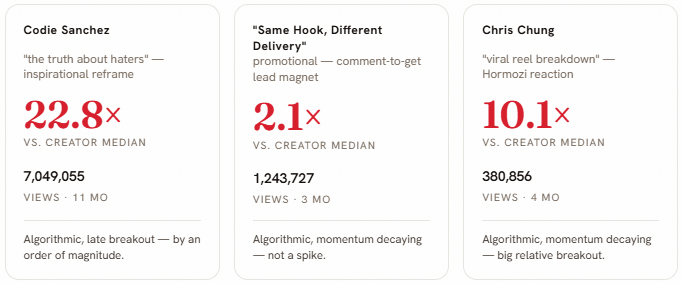
Here are the three posts we analyzed, each a strong performer in its own right:
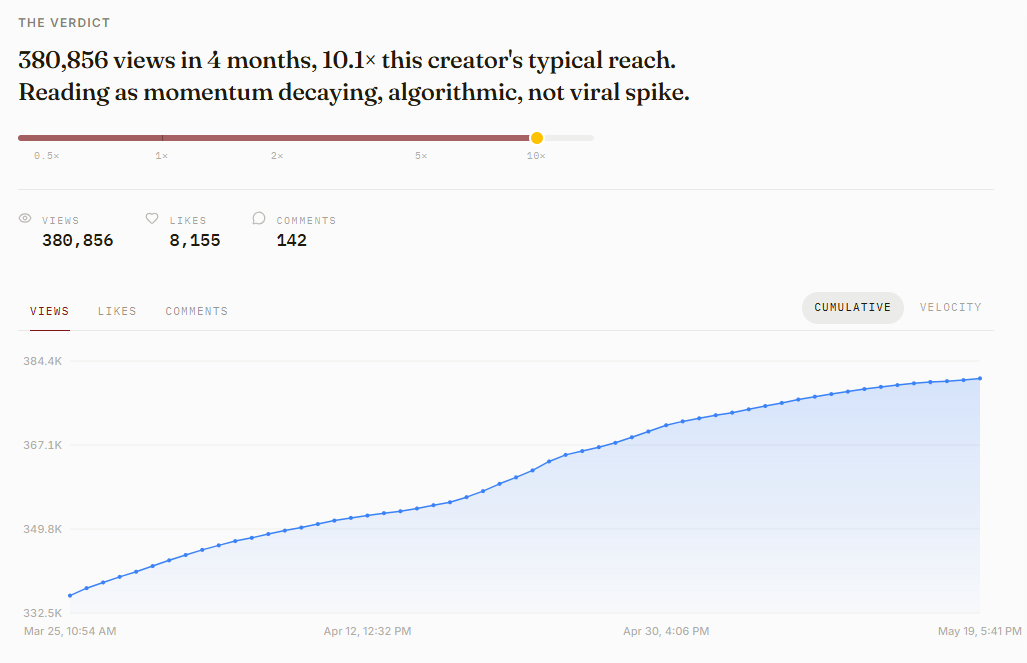
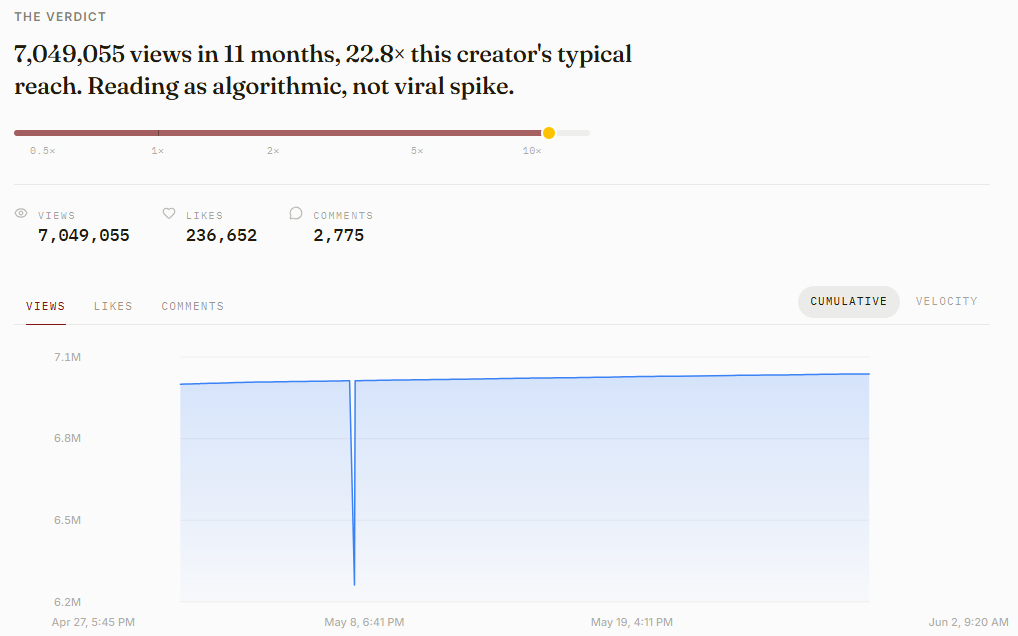
Now rank them. If you rank by raw views, the order is obvious. If you rank by how far each post outran its own account's typical reach, the middle two swap — and it isn't close:
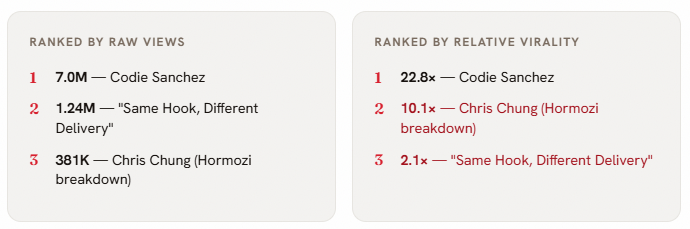
The 380K-view post is roughly a five-times bigger breakout for its account than the 1.24M-view post is for its. By the only measure that actually describes virality — performance relative to baseline — the smallest video on the list is more viral than the one with three times its views. Raw views measure reach. The multiplier measures virality. They are not the same number, and confusing them is how people learn the wrong lessons from the wrong videos.
Verify it's actually viral
So the first layer of any honest analysis is a sanity check on the premise. Views are the least useful number you can lead with. A million views on an account that always does a million views is a Tuesday, not a breakout. The only measure that means anything is reach relative to that account's median — which is exactly why the three verdicts above read so differently.
But the multiplier is only the start. The growth curve and engagement mix tell you the mechanism:
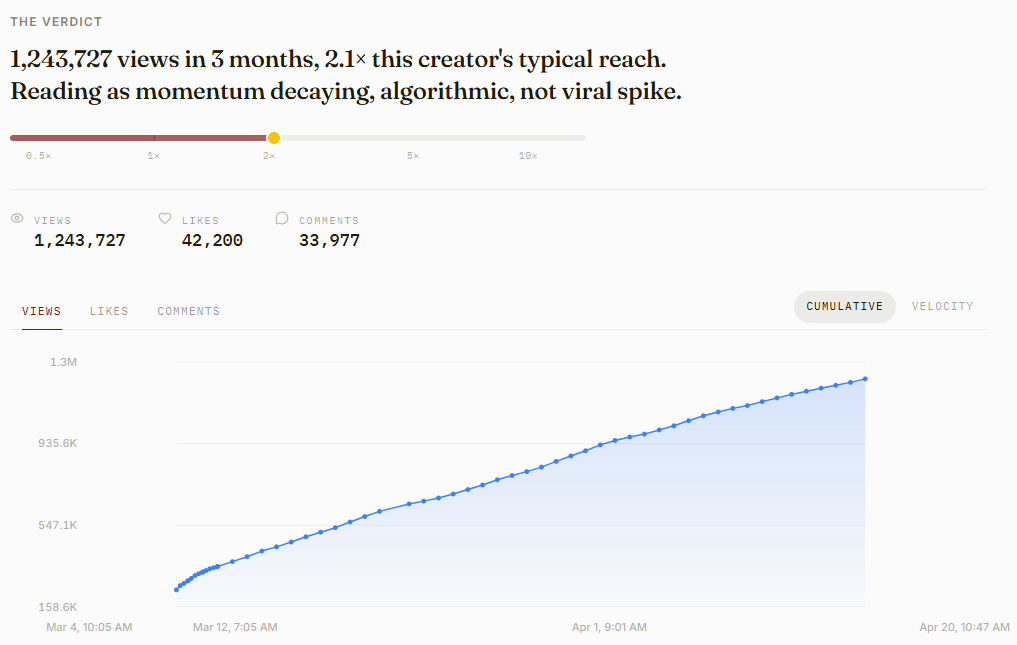
The curve names the engine. All three read as algorithmic rather than a sudden viral spike — but with a tell. Codie's post is a late breakout: it built slowly, then the algorithm caught it months in. The other two are standard decay: a climb that's now leveling off as the push runs its course. Same "algorithmic" label, different stage of life — and that changes whether you'd expect a similar post to peak fast or slow-burn.
Velocity — views and likes per hour in the early window — tells you whether the platform is still actively pushing a post or whether it has already peaked.
Read the engagement mix in the context of the CTA. This is where most people misread the data. The "Same Hook" post has 33,977 comments on 1.24M views — an enormous comment rate. That is not organic debate; it's a lead-magnet CTA ("comment '1,000' and I'll send you the hooks") manufacturing comments on purpose. Compare Codie's post: 7M views, 236K likes, only 2,775 comments — a broadcast-and-share signature for affirming, save-and-send content with little to argue about. Same metric, opposite meaning. The number is meaningless until you know what the post asked people to do.
The argument it wins on
Every post that outperforms wins on one core move. Name it before you dissect anything, because that's the part worth keeping. Across the three, the moves are clean and completely different:
Codie Sanchez wins on an "If [negative event], then [positive meaning]" reframe — turning a common pain point (being criticized) into a status-affirming narrative ("haters hate winners"). It's a high-value psychological reframe that's instantly shareable to anyone feeling social friction.
"Same Hook, Different Delivery" wins on a side-by-side comparison — showing a "bad" vs "good" execution of the same advice. It's "show, don't tell": four rapid-fire proof examples that land the point visually before the video asks for anything.
Chris Chung's Hormozi breakdown wins on a reaction-analysis hybrid — show a high-performing clip and explain the technical and psychological reason it worked, simultaneously. A high-authority figure plus a meta-analysis of why the content is working is catnip for the algorithm.
Three different arguments, one principle: the post is making a single bet, and everything else is delivery. Extract the bet and you have something; copy the delivery and miss the bet and you have nothing.
The first three seconds
The opening decides whether the rest happens. Analyze it as three hooks at once — visual, text, and audio — then name the scroll-stop mechanism. The three videos use two different ones:
Visual pattern interrupt (Same Hook): a split-screen montage with bold "Same Hook, Different Delivery" text, opening on a flat "sell me this pen," then the same line delivered with high energy. The juxtaposition breaks the scroll and the implied contradiction opens a curiosity gap — why is the same line landing so differently?
Visual pattern interrupt (Hormozi breakdown): a split-screen of Hormozi on a podcast over the creator reacting, with "SPEED TO VALUE / NO INTRO" overlaid and a provocative opening line. It skips the traditional intro entirely and borrows the authority figure's credibility in frame one.
Text intrigue (Codie Sanchez): no montage — just the creator, direct to camera, with centered white text: "Let me tell you the truth about haters." The contrarian-truth frame validates the viewer's experience and opens a gap that promises relief.
Structure and pacing
Once you know how a video hooks, map how it holds. Lay it on a timeline and label each beat. Here's the "Same Hook" post in full — a fast, 37-second build:
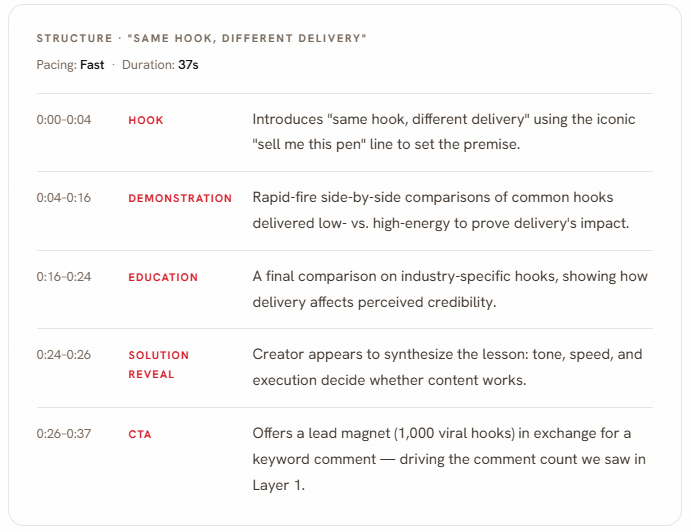
The other two run their own skeletons, and seeing all three together is the lesson:
Codie Sanchez (Fast, 26s): Hook → a rapid-fire run of "if/then" reframes → a synthesizing, empowering conclusion. Lean and almost entirely "education," no demonstration needed.
Chris Chung (Fast, 27s): Hook → Education (the editing trick) → Entertainment (the clip's punchline as the emotional peak) → Solution reveal (the psychological reason it hit). A reaction layered on top of borrowed content.
Different beats, same truth: every high-performing short video runs a recognizable skeleton, and the skeleton is the transferable part. Skeletons travel between niches. The flesh on them doesn't.
Psychology and persuasion
This is the layer the generic answers wave at ("it's emotional!") without doing the work. Get specific — name the target desire, the identity it hands the viewer, the objection it removes, and the emotional arc. Side by side:
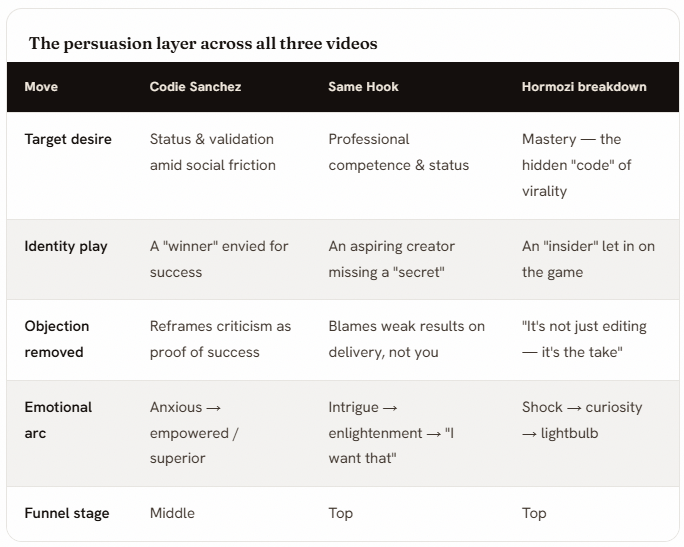
This is where you see why each one spread. Codie's reframe gives social currency — sharing it makes the sharer look like a winner. The "Same Hook" post manufactures action with an explicit lead-magnet CTA. The Hormozi breakdown sells insider status. If you've read Jonah Berger on why things spread, this is the operational version: high-arousal emotion plus social currency is what turns a watch into a share. You're naming the mechanism, not guessing at the feeling.

The replication blueprint
Now convert the analysis into something usable. The output of a real breakdown isn't a paragraph of admiration — it's a set of reusable templates, stripped of the original's specifics so you can drop your own in. Three real ones, pulled straight from the breakdowns:
Hook templates
Codie Sanchez: "Let me tell you the [adjective] truth about [common pain point]."
Same Hook: "Same [element], different [variable]. [Example A]. [Example B]."
Hormozi breakdown: "[Provocative statement from an authority figure] + [technical label for why it works]."
Structure & CTA templates
Codie: [Hook] → [rapid-fire reframing of pain points] → [synthesis of success] → [empowering conclusion]. CTA: "Tag your [target audience] who needs to hear this."
Same Hook: [Comparison of common mistake vs expert execution] → [why the difference matters] → [offer a big resource] → [keyword CTA]. CTA: "If you want [large number] [resource] from [successful source], comment [keyword]."
Hormozi breakdown: [Show viral clip] → [explain the editing trick] → [show the climax] → [explain the psychological reason]. CTA: label it "[Series] Part [N]" to imply a sequence and pull profile visits.
Break each down further into script-ready components — text hook, visual hook, emotional trigger, tone notes — and you've turned three videos you didn't make into assets you can. That's the deliverable. Everything in Layers 1–5 exists to produce this.
Adapt, never copy
The single most important rule of viral analysis: do not copy content. Extract hooks, formats, and structures — then adapt.
Copying gets you a worse version of someone else's idea, aimed at someone else's audience, serving someone else's positioning. Take the "Same Hook, Different Delivery" skeleton into a completely different niche and rebuild it with your audience's psychology, and it becomes yours — often outperforming the original because you've added relevance the original creator couldn't. The blueprint is a skeleton; your positioning and your audience's psychology are the flesh. Analysis without adaptation is just a thorough form of plagiarism.
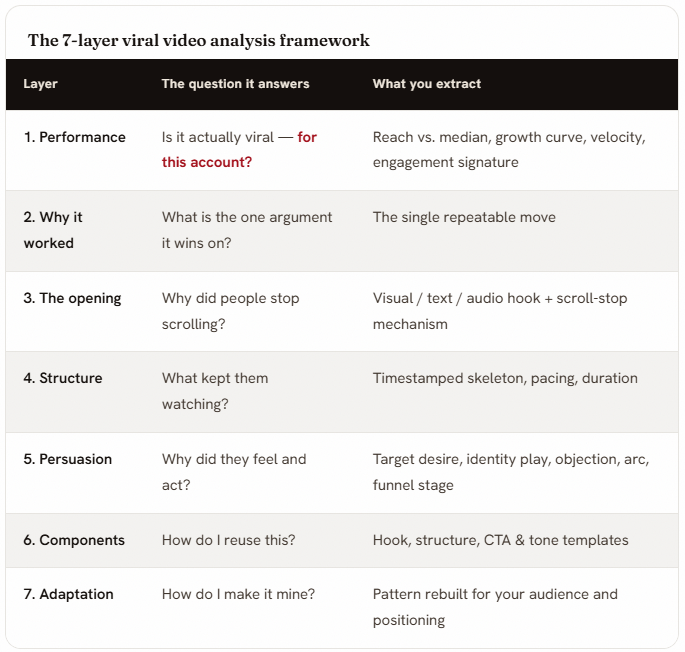
The framework at a glance
The whole method, as a reference. Each layer answers one question; together they explain why a video worked and how to use it.
Doing this by hand vs. automatically
You can run all seven layers manually, and you should learn to — it builds the instinct. But done by hand across a stack of competitor videos every month, this is the work that used to eat 8–10 hours in spreadsheets: pulling metrics, transcribing, timestamping the structure, writing up the psychology, building the templates. It's the exact research that makes serious strategists better than everyone else, and the exact reason most people skip it.
That's the gap Revlis closes. Every breakdown in this article — the verdict and multiplier, the hook analysis, the timestamped structure, the persuasion table, the replication blueprint — is what the system produces from a single pasted link, then sends straight into a script generator where you adapt it for your brand. The seven layers aren't a metaphor. They're literally the output. The thinking in this article is the product.
How do you analyze a viral video?
Break it into layers instead of guessing: verify it's actually viral relative to the account's own median, name the single argument it wins on, deconstruct the first three seconds, map the structure and pacing, name the psychology and persuasion, extract reusable templates for the hook, structure, CTA and tone, then adapt them to your brand rather than copying. The output should be a script-ready blueprint, not just an opinion about the video.
Is a video with 300,000 views viral?
It depends on the account. Virality is relative. In the three examples here, a 380K-view post was 10.1× its creator's typical reach, while a 1.24M-view post was only 2.1× its account's median — making the smaller post the bigger breakout by roughly five times. Always measure against the account's own baseline, not raw view count.
How can you tell if a video is actually viral or just did well?
Compare it to the account's typical performance. A multiplier like 10× or 22× signals a real breakout. The growth curve tells you the mechanism: a sudden steep spike usually means a bigger account or the recommendation engine picked it up, while a steady climb that levels off is algorithmic momentum decaying. A slow build that suddenly takes off months later is a "late breakout."
Should you copy a viral video?
No. Copying produces a weaker version of someone else's idea for someone else's audience. Extract the pattern — the hook template, the structure, the CTA approach, the tone — and adapt it to your own positioning and audience. Viral content gets views; strategic content built from extracted patterns gets results. Revlis extracts patterns from viral videos for you.
Can AI analyze a viral video for you?
Yes. Tools like Revlis let you paste any TikTok or Instagram link and return a full breakdown — performance verdict, hook analysis, a timestamped structure, the psychology and persuasion, and a replication blueprint you can turn into a script — in seconds, instead of the 8–10 hours manual analysis used to take.
Turn psychology into content that converts.
Explore the platform behind The RevList and start building smarter campaigns.